
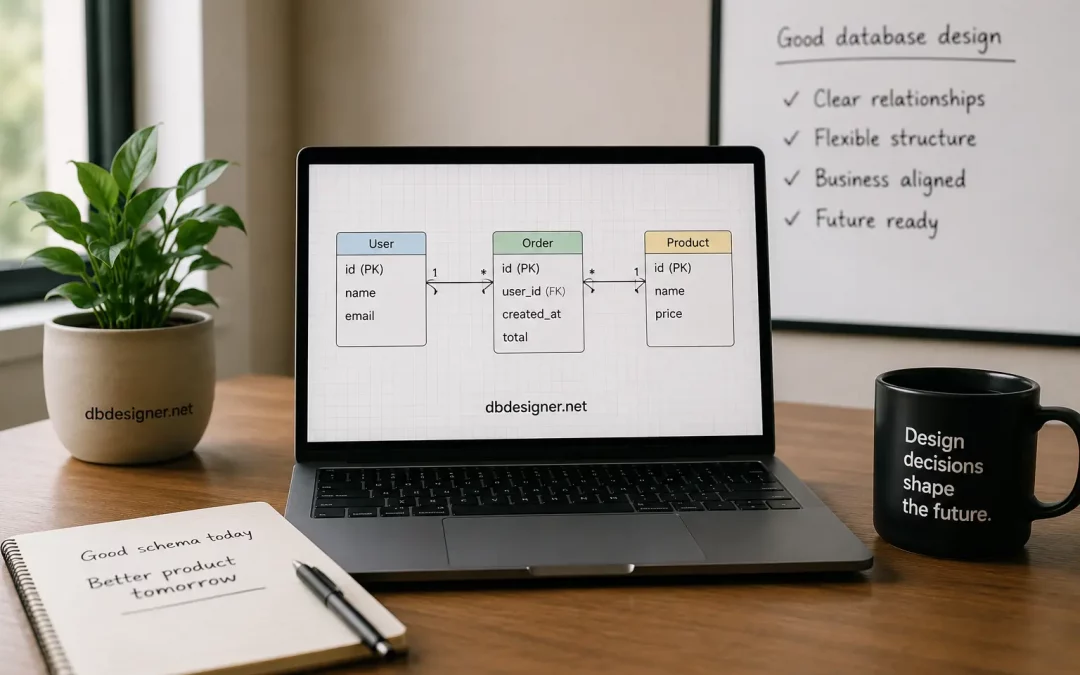
When Your Schema Becomes Product Policy: The Quiet Power of Database Design
Most software teams think they’re building features.
But underneath the interface, notifications, workflows, dashboards, and permissions, something else is quietly making decisions long before users ever click a button.
The schema.
A surprising amount of product behavior isn’t created in code—it’s inherited from database design. The structure of your data becomes an invisible policy engine. It determines what relationships exist, what changes are possible, what history survives, and which questions become expensive to ask later.
This is why good systems sometimes feel flexible even when requirements change—and why others become brittle after a few months.
The schema was making decisions all along.
This article explores a different way to think about schema design: not as a technical exercise, but as a process of deciding what your application believes about the world.
Every Table Is an Opinion About Reality
Imagine you’re building software for a coworking company.
You begin with what feels obvious:
- Users
- Spaces
- Bookings
Simple.
Then someone asks:
Can multiple companies share one booking?
Another question appears:
Can a booking change ownership?
Then:
Should we keep historical assignments?
Now the database starts revealing assumptions.
If your booking table contains a single company_id, you already decided ownership is singular.
If changing ownership overwrites old data, you decided history doesn’t matter.
If users belong directly to spaces instead of memberships, you decided relationships are permanent.
Those decisions may be right.
But they should be intentional.
Good database design is often less about organizing information and more about exposing hidden beliefs before they become difficult to change.
ER Diagrams Don’t Just Describe Systems—They Reveal Boundaries
People often treat ER diagrams as documentation produced after design work is finished.
In practice, they become more useful when treated as negotiation tools.
An ER diagram forces uncomfortable questions:
- Where does one concept end and another begin?
- Who owns this data?
- What can exist independently?
- What changes over time?
- What should never be deleted?
Consider a marketplace platform.
At first, you model:
- Customers
- Orders
- Products
Then refunds arrive.
If refunds become fields inside orders, you imply every order can only have one refund model.
If refunds become independent entities, you create room for partial refunds, approvals, and history.
The visual difference inside ER diagrams might seem small.
The operational consequences can be enormous.
That’s why tools that let teams iterate visually can be useful—not because diagrams replace thinking, but because they expose assumptions faster. Platforms such as DBDesigner and its visual workspace at ERD Designer are useful examples of this kind of exploration workflow.
The diagram itself isn’t the answer.
It simply makes your answers visible.
The Most Expensive Relationship Is Usually the Wrong One
People often worry about choosing the wrong data type.
Relationship choices usually cost more.
Suppose you’re designing a fitness application.
You create:
- User
- Workout
- Exercise
Easy enough.
Then someone asks for workout templates.
Then workout sharing.
Then team coaching.
Then version history.
Suddenly the original assumption—that workouts directly own exercises—starts collapsing.
The issue wasn’t performance.
The issue was meaning.
Was an exercise:
- a reusable definition?
- a completed action?
- a recommendation?
- a historical record?
One relationship hid four concepts.
Weak schemas often fail not because they lack complexity, but because they compress different meanings into the same structure.
A Common Assumption Worth Reversing: Not Everything Should Be “Current State”
Many people unconsciously model databases as snapshots.
The latest value wins.
But some systems become dramatically simpler when you stop storing only state.
Imagine employee roles.
A traditional model:
- Employee
- current_department
- current_title
Clean.
Until someone asks:
Who managed sales last February?
Now your schema starts leaking.
Instead of storing only current state, you might model assignments as history:
- Employee
- Role Assignment
- Effective Dates
Same business.
Completely different capabilities.
This shift changes how people think about schema design.
The question becomes:
Is this thing an object—or a sequence of events?
That single question often improves models more than memorizing design patterns.
What Weak Schema Decisions Actually Cost
Poor schemas rarely fail dramatically.
They fail quietly.
They produce product friction.
Examples appear everywhere:
- Users create duplicate accounts because identity rules were unclear.
- Teams cannot answer historical questions because updates overwrite meaning.
- Permissions become impossible to reason about because ownership wasn’t modeled.
- Reporting requires custom logic because business concepts never became entities.
Notice something interesting.
None of these sound like database problems.
They sound like product problems.
But product problems often begin as modeling decisions.
Applications inherit the strengths and weaknesses of their schemas more than most teams realize.
Schema Design Is Really About Choosing Future Questions
Here’s a useful thought experiment.
Before finalizing a model, ask:
What questions will this database make easy six months from now?
Not:
“Does the schema look clean?”
Ask:
- Can we explain why something changed?
- Can we represent exceptions?
- Can ownership move?
- Can relationships evolve?
- Can we preserve meaning over time?
A good schema does not predict every future requirement.
That’s impossible.
But it avoids freezing assumptions too early.
There’s a difference.
The Real Goal Isn’t Structure—It’s Honest Representation
Many articles teach database design as if there’s a perfect structure waiting to be discovered.
Reality is less elegant.
You’re building a representation.
Representations simplify.
They draw boundaries.
They preserve some truths while ignoring others.
That means every schema contains tradeoffs.
The skill is not eliminating tradeoffs.
The skill is making them visible.
That’s where thoughtful modeling, iterative ER diagrams, and deliberate schema design become valuable—not because they make systems rigid, but because they help teams understand what they’re committing to.
The strongest databases don’t feel clever.
They feel unsurprising.
Users ask for something new.
The product adapts.
The schema doesn’t panic.
And that may be the clearest sign that the design was doing more than storing data—it was quietly supporting the future all along.
Recent Comments