
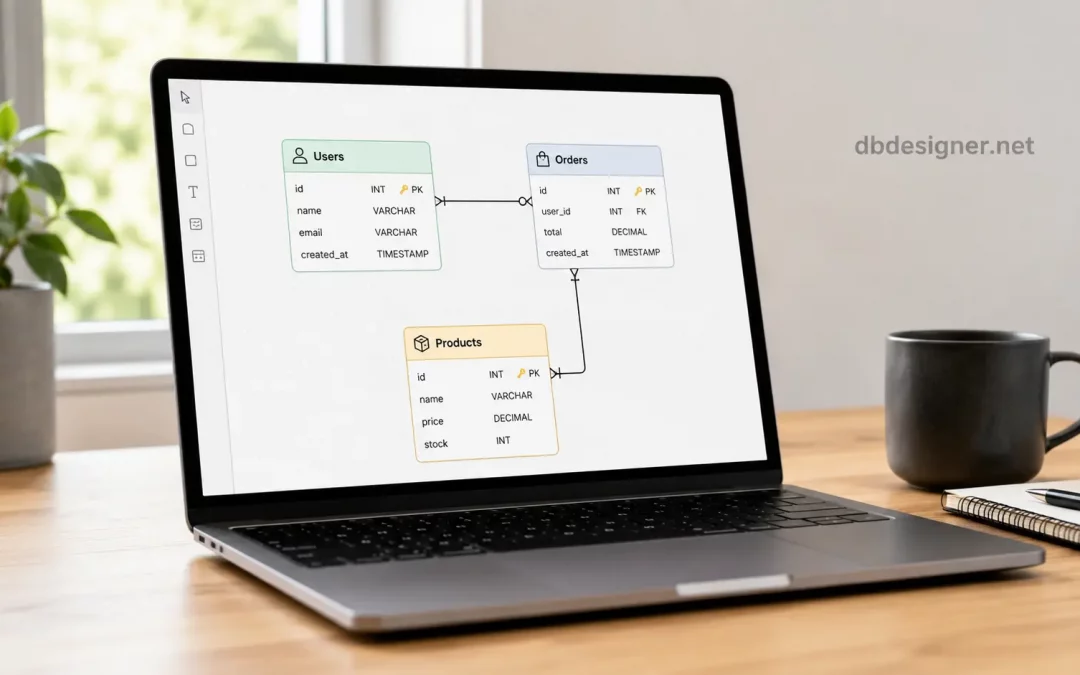
Your Database Is Quietly Deciding What Your Product Is Allowed to Become
A database rarely announces that it has made a product decision.
It does not join planning meetings, challenge a feature request, or leave comments in a design file. Yet every schema contains assumptions about what can exist, what can change, who owns what, and which events are worth remembering.
Those assumptions often remain invisible until the product tries to do something new.
A marketplace wants to let one order include items from multiple sellers. A publishing platform wants an article to have several authors. A subscription service wants customers to pause, resume, upgrade, and return without losing their history. Suddenly, a feature that looks simple in the interface requires awkward migrations, duplicated records, special-case code, and uncomfortable compromises.
The problem is not always that the original database design was technically incorrect. More often, it described the business too narrowly.
Good schema design is not just the process of organizing data. It is the process of deciding which versions of reality your application will be capable of representing.
A Schema Is a Collection of Business Claims
Imagine a small service marketplace with customers, professionals, and bookings.
The first version of the product allows a customer to book one professional for one service. A simple booking table might contain:
- a customer ID
- a professional ID
- a service ID
- a scheduled time
- a status
This looks perfectly reasonable. It may even be the best design for the initial product.
But the table is doing more than storing booking information. It is making several claims:
- Each booking belongs to exactly one customer.
- Each booking involves exactly one professional.
- Each booking represents exactly one service.
- The scheduled time belongs to the booking as a whole.
- A single status is enough to describe the booking’s lifecycle.
None of these claims are automatically true. They are decisions about how the business works.
Now suppose the company introduces group appointments, assistants, bundled services, or split scheduling. The original table begins to resist the product. Developers may add fields such as second_professional_id, store comma-separated service IDs, or create vague statuses like partially_completed.
These are not merely coding problems. They are signs that the schema’s business claims no longer match the product’s reality.
When reviewing database design, it helps to stop asking only, “Where should this data go?” and start asking, “What must be true for this structure to remain valid?”
The Most Expensive Relationship Is Often the One You Assumed Would Never Change
Relationship choices are among the most consequential decisions in ER diagrams because they determine which combinations of data are possible.
Consider a content platform where every article has one author. The initial schema places an author_id directly on the article record.
This is clear, efficient, and easy to understand. It also defines authorship as a one-to-many relationship: one author can write many articles, but each article can belong to only one author.
Later, the platform wants to support co-authored research, editorial collaborations, guest contributors, and translated editions with different credits.
The feature request may sound like a small interface change: allow users to select multiple authors. But the database has already declared that multiple authors cannot exist.
The team now has several options:
- Replace
author_idwith an article-author relationship table. - Keep a primary author and add secondary contributors elsewhere.
- Store authors in an unstructured field.
- Create separate article records for each contributor.
Each option affects application logic, permissions, search, notifications, analytics, and historical records.
The hidden cost of modeling the wrong relationship is not limited to changing a table. It spreads through every part of the application that learned to depend on the original assumption.
A page template may expect one author name. An API may return one author object. A permission rule may check whether the current user matches author_id. An analytics report may group articles by a single owner.
The schema did not merely store authorship. It taught the entire product what authorship meant.
Reframing a Common Assumption: Simpler Is Not Always Less Detailed
Database advice often encourages simplicity, and rightly so. Unnecessary complexity makes systems harder to understand and maintain.
But simplicity is frequently confused with compressing several concepts into one field or one table.
Suppose an order has a status field with values such as:
- pending
- paid
- packed
- shipped
- delivered
- cancelled
This seems simple. One column tells the application where the order stands.
But what happens when an order is paid, partially shipped, and partially refunded? What happens when delivery fails and the package returns to the warehouse? What happens when one item is cancelled but the rest continue?
The single status field is simple only because it hides several independent realities:
- payment state
- fulfillment state
- delivery state
- cancellation state
- refund state
A more detailed schema may actually be conceptually simpler because each part has one clear meaning.
The goal is not to create the fewest possible tables or fields. The goal is to create the fewest concepts necessary to describe the business without forcing unrelated facts into the same container.
A compact schema can still be complicated if every field carries several meanings.
This is why strong schema design often feels slightly more explicit than a first draft. It separates concepts that may change independently.
Ask Whether You Are Modeling State, History, or Both
Many weak schemas store only the latest truth.
A customer has a current address. A subscription has a current plan. A task has a current owner. An invoice has a current status.
For some products, that is enough. For others, it quietly destroys information the business will later need.
Consider a subscription table with these fields:
- customer ID
- plan ID
- status
- start date
When a customer upgrades, the application replaces the plan ID. When the customer cancels, it changes the status. When the customer returns, it changes the status again.
The table always shows the current subscription state, but it cannot reliably answer:
- Which plan was the customer on last month?
- How many times have they cancelled?
- How long did the paused period last?
- Was the upgrade immediate or scheduled?
- Which price did they actually agree to?
A team may attempt to reconstruct these answers from logs, payment records, or timestamps, but reconstruction is not the same as deliberate modeling.
The design question is not simply, “What is the subscription?” It is also, “Which changes to the subscription matter enough to preserve?”
This distinction appears everywhere:
- A task owner is state; ownership transfers are history.
- A product price is state; price changes are history.
- An account balance is state; transactions are history.
- A document version is state; edits and revisions are history.
Some applications need only current state. Some should derive current state from events. Many need a practical combination of both.
The mistake is not choosing one approach over another. The mistake is failing to recognize that a choice is being made.
Ownership Is Often More Complicated Than a Foreign Key
Ownership appears straightforward in early ER diagrams. A project has an owner. A file belongs to a user. An invoice belongs to a company.
Real products quickly complicate this idea.
Can ownership be transferred? Can several people share control? Does deleting the owner delete the resource? Can an organization own something that was created by an individual? Can a user leave the organization while their work remains?
Suppose a project table contains a single user_id. At first, this field may mean “the person who created the project.” Later, the application begins treating it as:
- the person who owns the project
- the person allowed to delete it
- the person billed for it
- the person shown in reports
- the person who receives notifications
One field has accumulated five different responsibilities.
This creates fragile behavior. Transferring billing responsibility might unexpectedly change permissions. Removing a user might orphan important records. Team collaboration might require pretending that one person owns shared work.
A better design starts by separating the questions:
- Who created the resource?
- Who currently owns it?
- Which organization contains it?
- Who can access it?
- Who pays for it?
Those answers may initially point to the same person, but they are not the same relationship.
Schema design becomes more durable when it models meanings rather than coincidences.
Naming Problems Are Usually Modeling Problems in Disguise
Teams often treat naming as a final cleanup task. In reality, difficulty naming a table or field can reveal that its purpose is unclear.
A column called type raises immediate questions. Type of what? Is it a permanent category, a temporary state, a user-selected option, or a system-generated classification?
A table called activity may contain comments, logins, purchases, exports, status changes, and notifications. The name sounds flexible, but its flexibility may hide several unrelated concepts.
Ambiguous names encourage ambiguous code. Developers begin relying on comments, tribal knowledge, and conditional logic to understand what a value means.
Consider a field called completed_at. It could mean:
- the user finished the task
- the system processed the task
- the result was approved
- the workflow reached its final state
- the record was archived
If the team cannot agree on the meaning, the problem is not vocabulary. The underlying event has not been modeled clearly.
Precise naming forces useful conversations. A field named submitted_at is different from approved_at. A creator_id is different from an owner_id. A billing_customer_id is different from an account_id.
Good names make business rules visible. Weak names postpone decisions until they become bugs.
What a Weak Schema Decision Looks Like Months Later
Imagine a support platform where each ticket contains an assigned_agent_id. The system overwrites this value whenever the ticket is reassigned.
At launch, this works well. Managers only need to know who currently owns each ticket.
Months later, the company wants to answer several operational questions:
- How often are tickets reassigned?
- Which teams receive the most incorrect assignments?
- How long does a ticket wait between owners?
- Who handled the ticket before it was escalated?
- Did the service-level deadline expire before or after reassignment?
The current schema cannot answer these questions because every reassignment erased the previous one.
The consequences spread beyond reporting.
Customer complaints become harder to investigate. Managers cannot distinguish slow resolution from excessive routing. Automated escalation rules lack reliable context. Performance reviews depend on incomplete data. The business may make staffing decisions based on misleading averages.
A weak schema decision often remains invisible while the application is performing its basic workflow. It becomes visible when the organization tries to learn from that workflow.
This is an important test for database design: can the model support not only the action itself, but also the questions people will ask about the action later?
Use ER Diagrams to Expose Assumptions, Not Just Display Tables
ER diagrams are most valuable when they help a team inspect the meaning of a system before that meaning becomes code.
A diagram should make it easier to ask:
- Is this relationship truly one-to-one?
- Can this record exist without that record?
- What happens when ownership changes?
- Are we storing current state, historical events, or both?
- Does this table represent one concept or several?
- Which business rule is enforced by this relationship?
Drawing the schema makes hidden assumptions visible. A direct foreign key communicates one kind of relationship. A junction table communicates another. A separate history table signals that change over time matters.
Tools such as DB Designer can be useful for exploring these structures visually, especially when a team needs to compare multiple versions of a model. For a more focused ER diagram workflow, the ERD editor provides a practical space to map entities and relationships before implementation.
The value does not come from making the diagram look polished. It comes from using the diagram to challenge statements that sound obvious.
“Every order has one customer.”
Does guest checkout count? Can orders be merged? Can a business account place an order through an employee?
“Every document has one owner.”
Can a team own it? Can ownership be transferred? Does the creator remain visible after leaving?
“Every payment belongs to one invoice.”
Can one payment cover several invoices? Can several payments cover one invoice? Can credit be applied without a payment?
The diagram becomes useful when it turns assumptions into questions.
Design for Meaningful Change, Not Every Imagined Future
Recognizing hidden assumptions does not mean building a schema for every possible feature.
Overengineering is still a risk. A small product does not need twenty relationship tables merely because the business might become more complex someday.
The better approach is to distinguish between imaginary flexibility and meaningful flexibility.
Imaginary flexibility prepares for possibilities with no evidence behind them. Meaningful flexibility accounts for changes that are already suggested by the domain.
For example:
- A publishing platform should seriously consider co-authorship because collaborative writing is common.
- A payment system should expect partial payments, refunds, and retries because money movement naturally creates these cases.
- A team collaboration tool should separate creators, owners, and members because people and organizations change.
- A temporary event landing page may not need a sophisticated ownership-history model.
The strongest database design is not the design with the most abstraction. It is the design whose abstractions match the kinds of change the product is likely to experience.
A useful question is:
If this assumption becomes false, how much of the system will need to change?
If the answer is “almost everything,” the assumption deserves closer attention before implementation.
Let Constraints Describe the Reality You Actually Want
A schema does not merely permit data. It can also prevent invalid versions of reality.
If an appointment must always have a start time before its end time, that is a business rule. If an invitation cannot be accepted after it expires, that is a business rule. If a membership must belong to both a user and an organization, that is a business rule.
Some rules are enforced in application code. Others are represented through required fields, unique constraints, foreign keys, or relationship structures.
The important point is that constraints are not just technical safeguards. They are statements about what the business considers valid.
A schema with almost no constraints may feel flexible, but it transfers the responsibility for meaning into every piece of code that reads or writes the data. Different parts of the application may interpret the same record differently.
A schema with thoughtful constraints gives the system a shared definition of reality.
This does not mean every rule belongs in the database. Some rules depend on context, timing, permissions, or external services. But every important rule should have a deliberate home.
When no one knows where a rule is enforced, it is usually enforced inconsistently.
The Questions Worth Asking Before the Schema Hardens
Before finalizing a model, walk through situations that place pressure on its assumptions.
- What can change ownership?
Consider users leaving, companies merging, projects transferring, and shared resources. - What can happen more than once?
Look for repeated payments, retries, approvals, cancellations, assignments, and renewals. - What can be partial?
Orders may be partially fulfilled, invoices partially paid, and workflows partially completed. - What history will people expect later?
Think about audits, support investigations, analytics, disputes, and operational learning. - Which concepts only look identical today?
Creator and owner, account and payer, status and outcome, price and amount charged may later diverge. - What rule does each relationship express?
Do not add a foreign key without understanding the business claim it creates.
These questions do not predict every future requirement. They reveal where the current model is making a strong commitment.
Your Product Will Eventually Meet the Edges of Its Data Model
Every schema is a simplified representation of reality. It has to be. Real businesses contain exceptions, changing roles, incomplete information, overlapping timelines, and rules that evolve.
The goal of schema design is not to capture reality perfectly. It is to simplify reality without erasing the distinctions the product will later depend on.
A strong schema makes important concepts explicit. It distinguishes current state from meaningful history. It treats relationships as business decisions. It uses names and constraints to communicate what records actually mean.
A weak schema may still work for months. Users can create accounts, place orders, schedule appointments, and publish content. The weakness appears when the product tries to grow beyond the assumptions embedded in its first version.
At that point, the database is no longer just storing the product’s data. It is negotiating with the product’s future.
The most valuable question in database design may therefore be neither “Which tables do we need?” nor “How should these entities connect?”
It may be this:
What version of the business are we making easy to represent—and which versions are we quietly making impossible?
Recent Comments