
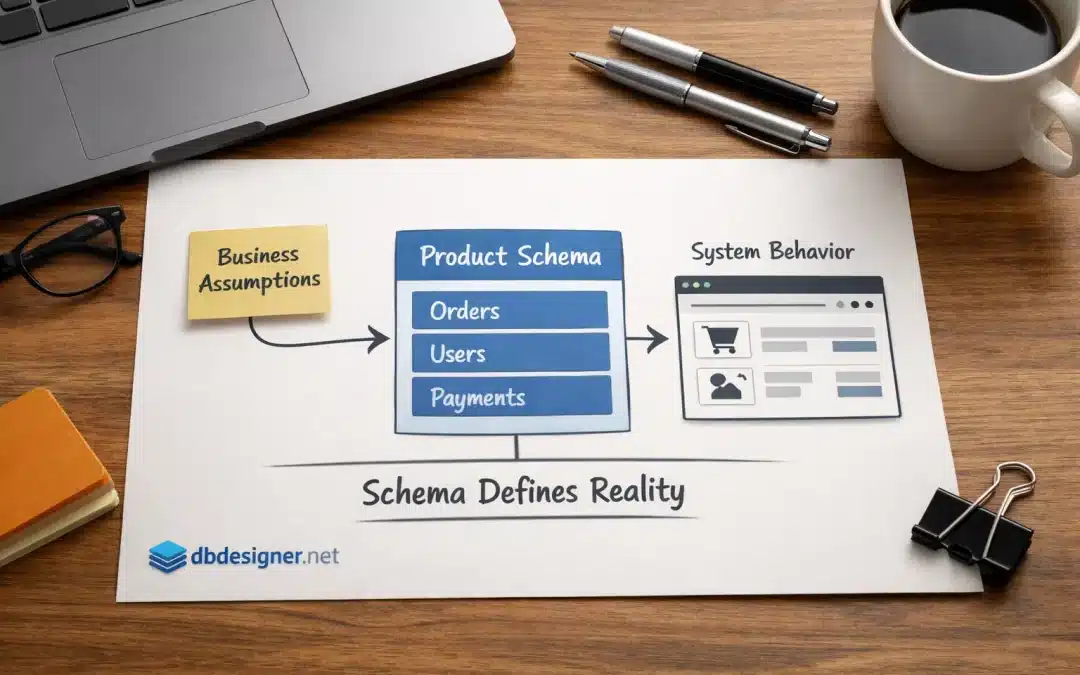
The Schema Is the Product: How Database Design Quietly Defines What Your Business Believes
Most teams treat database design as a technical step—something that happens after the “real” decisions are made. You gather requirements, sketch some ER diagrams, create tables, and move on.
But here’s the uncomfortable truth: your schema isn’t just storing your business logic—it’s deciding it.
Every table, every relationship, every constraint embeds assumptions about how your product works. And once those assumptions harden into schema design, they start shaping everything else—your APIs, your UI, your edge cases, even your future roadmap.
This isn’t a philosophical point. It’s practical. If you’ve ever struggled to change a feature that “should be simple,” chances are your database design quietly made it complicated long before the code did.
This article explores how schema design reveals (and locks in) business assumptions—and how to think more clearly about that before it’s too late.
Every Table Is a Claim About Reality
When you design a table, you’re not just organizing data—you’re making a claim about what exists.
Consider a simple example: an e-commerce system.
You create a “users” table. That sounds obvious. But what exactly is a user?
- A person?
- An account?
- An email address?
- A login identity?
Different answers lead to different schema design decisions:
- If a user is a person, you might allow multiple accounts per person.
- If a user is an account, you may treat email as unique and central.
- If a user is just a login identity, you might separate authentication from profiles entirely.
All of these are valid. But each one creates a different system.
This is where ER diagrams stop being diagrams and start becoming arguments. When you map entities and relationships—whether on paper or using tools like dbdesigner.net or erd.dbdesigner.net—you’re not just visualizing data. You’re choosing which version of reality your system will enforce.
And once that choice is made, everything downstream follows it.
The Illusion of “Neutral” Schema Design
There’s a common belief that database design is neutral—that it simply reflects requirements.
In reality, schema design is interpretive. It forces clarity where requirements are vague.
Take something as simple as “orders.”
You might assume an order belongs to a user. So you create a foreign key: orders.user_id.
Seems harmless.
Until later, when your product introduces:
- Guest checkout
- Shared accounts
- Corporate buyers with multiple users
Now your original assumption—that an order belongs to exactly one user—becomes a constraint you have to fight.
The schema didn’t just reflect your system. It froze a simplified version of it.
This is the subtle danger: schema design often hides decisions that feel temporary but behave like permanent truths.
Relationships Are Where the Real Decisions Live
Tables get most of the attention, but relationships are where database design becomes truly consequential.
Let’s say you’re modeling a subscription product.
You have:
- Users
- Plans
- Subscriptions
The obvious structure is:
- A user has one subscription
- A subscription belongs to one plan
Clean. Simple. Logical.
But now consider real-world behavior:
- Users upgrade plans mid-cycle
- Promotions temporarily change pricing
- Billing cycles don’t align with usage periods
If your schema models subscription as a static link between user and plan, you’ve just erased time from the system.
And that decision will come back later in painful ways:
- You can’t reconstruct billing history cleanly
- Analytics become guesswork
- Edge cases multiply in code instead of living in data
A more thoughtful schema might treat subscriptions as evolving over time—capturing state changes instead of fixed relationships.
This is the deeper layer of database design: deciding whether something is a snapshot or a timeline.
Reframing a Common Assumption: “Keep It Simple” Isn’t Always Simple
There’s a popular principle in schema design: keep it simple.
It’s good advice—but often misunderstood.
Many teams interpret simplicity as fewer tables, fewer relationships, and fewer concepts.
But that kind of simplicity often pushes complexity somewhere else—usually into application code.
For example, consider storing product pricing:
Option A: Add a price column to the products table.
Option B: Create a separate pricing model that handles versions, discounts, and time ranges.
Option A looks simpler. And early on, it is.
But as soon as your business introduces:
- Regional pricing
- Historical price tracking
- Limited-time offers
That “simple” schema starts to fracture. You add flags, exceptions, and conditional logic—none of which belong in the original design.
Option B, while more complex upfront, aligns better with reality.
So the real question isn’t “is this simple?”
It’s: “Where does the complexity live—and is it visible?”
Good database design doesn’t eliminate complexity. It places it where it can be understood and managed.
The Hidden Cost of Modeling the Wrong Boundary
One of the most expensive mistakes in schema design isn’t incorrect relationships—it’s incorrect boundaries.
Boundaries define what belongs together.
Consider a marketplace platform.
You might model orders like this:
- An order contains multiple items
- Each item belongs to a seller
That seems fine—until you realize:
- Different sellers have different shipping rules
- Payments may be split across sellers
- Refunds may apply to individual sellers, not the whole order
Now your “order” is doing too much.
You’ve bundled multiple independent transactions into a single entity.
The result?
- Complex business logic scattered across services
- Difficult reporting and reconciliation
- Fragile assumptions about what an order represents
A better schema design might introduce a concept like “sub-orders” or “seller orders,” reflecting the real boundaries of the system.
This is a key insight: your schema doesn’t just store data—it defines where one concept ends and another begins.
Why Weak Schemas Create Product Problems (Not Just Technical Debt)
It’s easy to think of poor database design as a technical issue.
But weak schemas don’t just slow down engineers—they distort the product itself.
Here’s how that happens:
1. Features become harder to express
If your schema doesn’t represent a concept cleanly, every new feature involving that concept becomes awkward.
2. Edge cases multiply
When the data model doesn’t match reality, edge cases aren’t rare—they’re everywhere.
3. Product decisions get constrained
Teams avoid building certain features not because they’re bad ideas, but because the schema makes them painful.
4. Data loses meaning
When tables mix responsibilities or relationships are unclear, data becomes harder to interpret—even for internal teams.
This is why database design matters beyond engineering. It shapes what your product can easily become.
Designing for Change Without Designing for Everything
One of the hardest tensions in schema design is balancing flexibility with clarity.
You don’t want to over-engineer for hypothetical scenarios. But you also don’t want to lock yourself into fragile assumptions.
A useful mental shift is this:
Design for likely change patterns, not hypothetical features.
For example:
- If pricing changes over time, model time explicitly.
- If ownership can shift, avoid hardcoding single ownership relationships.
- If history matters, don’t overwrite it—capture it.
This doesn’t mean building complex systems upfront. It means recognizing where reality is inherently dynamic and reflecting that in your schema.
Good ER diagrams don’t try to predict the future. They acknowledge where the present is already more nuanced than it appears.
Naming Is Not Cosmetic—It’s Structural
Another overlooked aspect of database design is naming.
Names aren’t just labels. They shape how people think about the system.
Consider the difference between:
orderstransactionspurchases
Each name carries different assumptions:
- “Orders” suggests intent
- “Transactions” suggests financial events
- “Purchases” suggests completed outcomes
If your schema uses “orders” to represent something that behaves like transactions, confusion is inevitable.
Developers will misinterpret data. Analysts will draw incorrect conclusions. Features will be built on shaky ground.
Clear naming isn’t about style—it’s about aligning the mental model of everyone who interacts with the system.
Your ER Diagram Is a Negotiation, Not a Diagram
It’s tempting to treat ER diagrams as static artifacts—something you create once and refine over time.
But in practice, they’re more like negotiation spaces.
When you map entities and relationships, you’re often resolving disagreements:
- What counts as a “user”?
- When does something become an “order”?
- Is this a property or a separate entity?
Tools like dbdesigner.net or erd.dbdesigner.net make it easier to visualize these decisions, but the real work happens in the discussions behind them.
The best schema designs emerge from these conversations—not from blindly applying patterns.
The Real Skill: Seeing the Assumptions Before They Solidify
Strong database design isn’t about memorizing rules or following best practices.
It’s about noticing the assumptions you’re making before they become constraints.
Before adding a column or relationship, ask:
- What am I assuming is always true?
- What would break if this assumption changes?
- Am I modeling reality—or a simplified version of it?
You won’t always get it right. No schema is perfect.
But the difference between a resilient system and a fragile one often comes down to how consciously those early decisions were made.
Conclusion: Your Schema Is Already Making Decisions—Make Them Deliberately
Database design doesn’t sit quietly behind your application. It actively shapes it.
The structure of your schema determines what your system can express easily, what it struggles with, and what it silently ignores.
That’s why good schema design isn’t about perfection. It’s about awareness.
Awareness that every table is a claim.
Every relationship is a constraint.
Every ER diagram is a decision about how your system understands the world.
When you approach database design with that mindset, you stop treating it as a technical task—and start treating it as what it really is:
The foundation of how your product thinks.
Recent Comments