
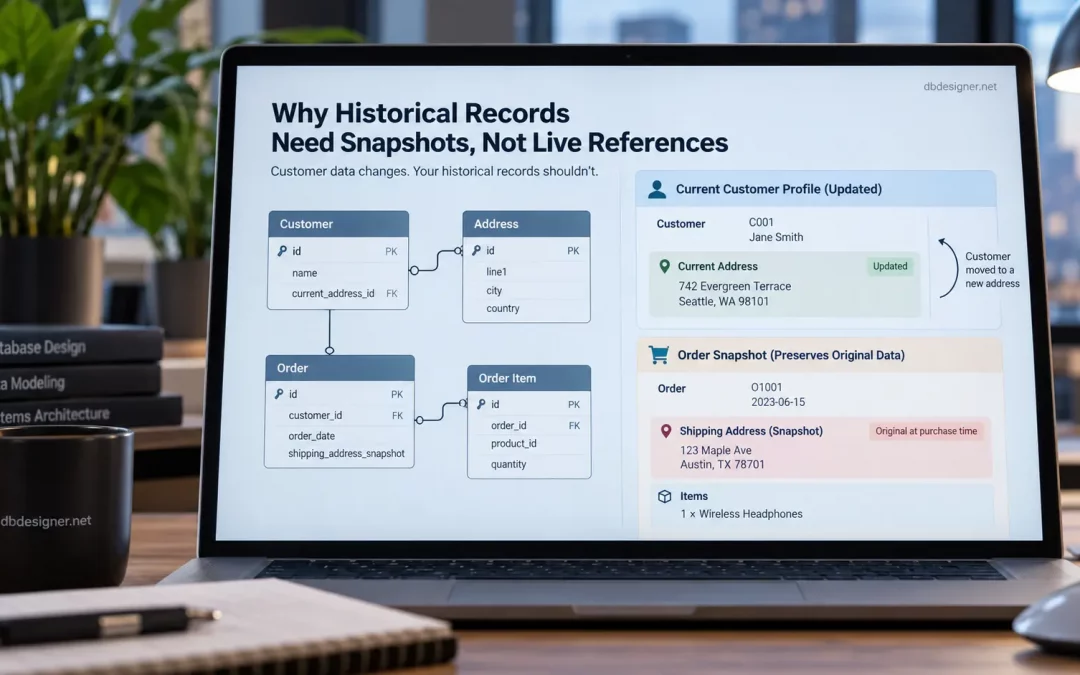
Why Historical Records Need Snapshots, Not Live References
A customer places an order on Monday. On Friday, they update their delivery address.
Nothing unusual has happened. Yet when support opens Monday’s order, the system now shows Friday’s address.
The database is technically consistent. The foreign key still works. The customer record exists. The address relationship is valid.
But the order is historically wrong.
This is a common data modeling problem: a record that describes something that happened in the past points to another record that continues changing in the present.
Good database design has to distinguish between live references and historical snapshots. The difference matters in orders, invoices, bookings, shipments, subscriptions, contracts, laboratory records, financial documents, and many other systems.
The innocent-looking schema that causes the problem
Imagine an e-commerce application with these entities:
customers
addresses
orders
products
order_items
A developer might initially model an order like this:
orders(id, customer_id, shipping_address_id, ordered_at)
And an order item like this:
order_items(id, order_id, product_id, quantity)
The structure looks clean. Relationships are normalized, duplication is limited, and the resulting ER diagram is easy to understand.
Now inspect what happens over time.
At checkout, address 41 contains:
17 Garden Street, Apartment 4, Lahore
The order stores:
shipping_address_id = 41
Two weeks later, the customer moves and edits address 41:
82 Canal Road, Lahore
If the order screen joins the order to the current address record, the old order now appears to have been shipped to Canal Road.
The database has preserved the identity of an address row. It has not preserved the facts that were true when the order was created.
A foreign key does not automatically preserve historical truth
One assumption worth challenging is that avoiding duplicated data always produces a better relational database.
It does not.
Duplication becomes dangerous when multiple copies are supposed to represent the same changing fact. But historical records often represent different facts at different moments.
“The customer currently lives at 82 Canal Road” and “Order 781 was shipped to 17 Garden Street” are not competing copies of the same information.
They answer different questions.
The customer table describes current state. The order describes a completed transaction.
That distinction should appear in the database schema.
Snapshot the values that belong to the transaction
A stronger order model might store shipping details directly with the order:
orders(
id,
customer_id,
shipping_name,
shipping_line_1,
shipping_line_2,
shipping_city,
shipping_postal_code,
shipping_country,
ordered_at
)
The customer still has reusable address records. Those records help populate checkout forms and represent the customer’s current saved addresses.
But once the order is confirmed, the relevant values become part of the order itself.
The database is effectively saying:
This is the address information accepted for this transaction at this moment.
Changing the customer profile later does not rewrite history.
This pattern can be modeled clearly before implementation using an ER diagram modeling tool. Drawing the current customer address separately from the order’s shipping snapshot often exposes the distinction immediately.
Prices reveal the same problem even faster
Product prices provide another useful test.
Suppose an order item contains only:
product_id = 903
quantity = 2
Product 903 currently costs $40.
The application calculates the historical order line as:
2 × current product price
That seems acceptable until the price changes to $55.
The original $80 order suddenly appears to be worth $110.
A transaction model therefore usually needs something like:
order_items(id, order_id, product_id, product_name, unit_price, quantity)
The product_id still connects the transaction to the product that generated it. The stored unit_price captures the value actually agreed upon.
Even storing product_name may be justified when receipts, invoices, or customer history must continue showing the description that existed at purchase time.
This is not careless denormalization. It is intentional preservation of historical facts.
Investigate the lifecycle before deciding what to snapshot
The right question is not simply, “Should this field be duplicated?”
Instead ask:
- Can the referenced record change after this transaction is created?
- If it changes, should old records show the new value or the old one?
- Would reproducing the original document require the historical value?
- Does the business care about what was known, promised, priced, classified, or delivered at that time?
These questions turn schema design into an investigation of the business lifecycle.
For example, examine several real or simulated orders. Change customer names, addresses, product descriptions, tax rates, and prices. Then reopen the historical orders.
Ask whether they still describe what actually happened.
This simple experiment often finds weaknesses that an ER diagram alone will not reveal.
Not every relationship should become a snapshot
Snapshots are useful, but copying everything would create a different problem.
Suppose an order belongs to customer 127. If the customer changes their phone number, you may still want the order to remain associated with that same customer account.
There is usually no reason to replace customer_id with a copied customer record.
A practical design often uses both approaches:
- Reference identity when the relationship should remain connected to a continuing entity.
- Snapshot transaction facts when historical values must remain unchanged.
An order might therefore keep customer_id while snapshotting the delivery address, item description, agreed price, taxes, and other transaction-specific values.
The skill is deciding which data represents an entity and which data represents evidence of an event.
Snapshots also protect you from deleted or retired data
Mutable data is not the only risk.
Referenced records may eventually be archived or removed.
Imagine a hotel booking system where the booking references a room type:
booking.room_type_id = 7
Room type 7 was called “Executive Twin” when the booking was made. A year later, the hotel reorganizes its inventory and retires that room type.
If historical bookings depend entirely on the live room-type record, reporting and customer service become unnecessarily fragile.
A booking snapshot might preserve:
room_type_id
room_type_name
nightly_rate
occupancy_limit
The foreign key provides lineage. The snapshot preserves meaning.
This distinction becomes particularly important during database migrations and legacy schema modernization, where supposedly harmless cleanup can reveal how much historical data depends on mutable reference records.
The weak alternative: rebuilding history from today’s data
A common weak approach is to store as little transactional data as possible and reconstruct historical records with joins.
This works beautifully while the referenced data remains unchanged.
Months later, the application begins accumulating exceptions:
“Use the current address unless the order was already shipped.”
“Use the latest product name unless an invoice exists.”
“Use the current tax category except for orders before the tax change.”
At that point, application logic is trying to recreate information the database failed to preserve.
The consequences can include incorrect invoices, confusing support screens, unreliable reports, broken audit trails, and migrations that silently alter historical interpretation.
Model snapshots explicitly in your ER diagrams
When reviewing an unfamiliar database, look for entities representing completed or committed events:
orders, invoices, bookings, shipments, contracts, payments, assessments, measurements, approvals, and published records.
Then trace their foreign keys.
If those entities depend heavily on tables containing editable current-state information, investigate whether history can change accidentally.
This is a useful exercise for database engineers as well as developers learning data modeling. The database design resources on DBDesigner can help with the broader modeling process, while an ER diagram can make the boundary between live entities and historical facts visible.
A practical rule: preserve what you would need to replay the moment
Before finalizing a transactional database schema, imagine that every mutable reference table disappears five years from now.
Could you still answer the important historical questions?
What did the customer buy?
What price was accepted?
Where was the package supposed to go?
What classification applied?
What terms were recorded?
You do not need to copy every available attribute. You need to preserve the values that define the meaning of the transaction.
That is the deeper purpose of snapshot data modeling.
A database should not merely tell you what the world looks like now. When the system records transactions, commitments, measurements, or decisions, it should also be able to tell you what was true when those events happened.
Sometimes the most accurate schema is the one that deliberately refuses to follow the latest value.
Recent Comments