
How to Design a Database for Recurring Appointments and Schedule Exceptions
A customer books a workshop every Wednesday at 9:00 AM. Three weeks later, the instructor moves one session to Thursday. The following week is canceled because the building is closed. Meanwhile, several participants have already registered for individual sessions.
What should happen to the database?
Should the application update the original recurring schedule? Create new appointment records? Delete canceled sessions? Or maintain a separate record for every exception?
These questions reveal one of the more interesting problems in database design: a recurring schedule is not the same thing as the appointments it produces.
Many scheduling systems initially treat recurring appointments as ordinary records with a repeat flag. That approach works until people begin rescheduling individual occurrences, canceling dates, changing time zones, or attaching attendance records to specific appointments.
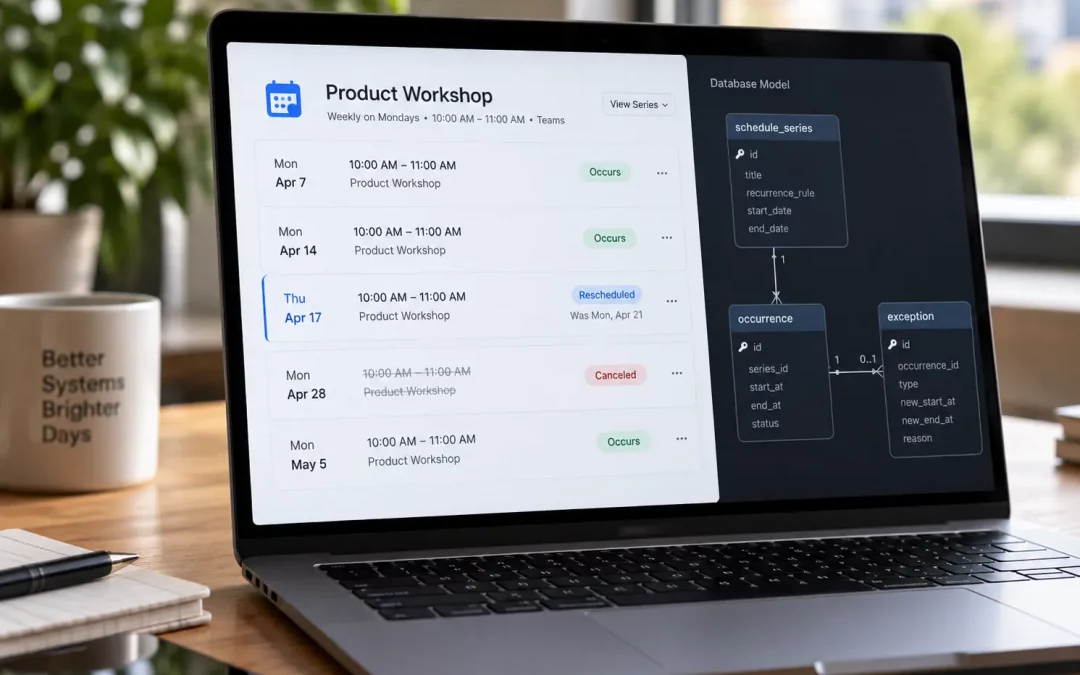
The solution requires distinguishing three concepts: the repeating rule, the individual occurrence, and any changes made to that occurrence.
Let’s investigate how these concepts translate into a relational database schema that can support real scheduling behavior.
Why a Recurring Appointment Is Not Just a Repeated Record
Imagine a community makerspace that runs a weekly equipment safety workshop.
The initial scheduling requirements are straightforward:
- Workshop: Laser Cutter Safety Training
- Day: Every Wednesday
- Start time: 9:00 AM
- Duration: 60 minutes
- Time zone: America/New_York
- Schedule period: October through December 2026
A developer could generate twelve appointment records and insert them into an appointments table.
At first, this seems reasonable. Each record has a start time, end time, instructor, and workshop identifier.
But consider what happens when the instructor changes the workshop time for all remaining Wednesdays.
The application must identify every future record and update it. If one session was already moved manually, should that exception also move? What happens to registrations attached to the modified sessions?
Now imagine the workshop repeats indefinitely. Generating every future occurrence becomes impossible, while generating an arbitrary number introduces another problem: the database no longer clearly distinguishes the repeating definition from its generated results.
There is an alternative approach: store one appointment and calculate all future occurrences whenever someone opens the calendar.
That avoids generating hundreds of records, but it introduces a different limitation. Where does the system store the fact that November 11 was moved or November 18 was canceled?
Neither approach is necessarily wrong. Both become problematic when the database fails to represent the different kinds of scheduling information separately.
Investigate What Actually Changes in a Schedule
Before designing the schema, examine several realistic scheduling events.
Consider these records from the makerspace:
October 28, 2026: The workshop takes place at its regular Wednesday time.
November 4, 2026: The workshop follows the normal schedule.
November 11, 2026: The instructor moves this particular workshop to Thursday, November 12, at 11:00 AM.
November 18, 2026: The workshop is canceled because the building is unavailable.
November 25, 2026: The workshop returns to its normal Wednesday schedule.
These examples expose an important distinction.
The November 11 workshop still belongs to the Wednesday series, even though participants will attend it on Thursday.
Similarly, the November 18 workshop remains part of the original recurrence pattern, even though it will not take place.
A cancellation does not mean the scheduled occurrence never existed. It means the occurrence has a different outcome.
This leads to the central modeling insight:
Recurring schedules describe when appointments are expected to happen. Occurrence records and exceptions describe what actually happens to specific appointments.
Once those responsibilities are separated, many difficult scheduling operations become easier to reason about.
Start With a Table That Describes the Recurrence Rule
The first entity should represent the recurring schedule itself.
Call it schedule_series.
A practical version might contain these fields:
series_id— unique identifier for the repeating schedule.title— descriptive name of the appointment or workshop.starts_on— date when the recurrence begins.ends_on— optional final recurrence date.local_start_time— intended wall-clock starting time.timezone_id— named time zone used to interpret the schedule.duration_minutes— normal appointment duration.recurrence_rule— definition of the repeating pattern.
For the makerspace, a record could have series_id = 42, local_start_time = 09:00, timezone_id = America/New_York, and a rule equivalent to FREQ=WEEKLY;BYDAY=WE.
The recurrence rule expresses the relationship between dates rather than storing each date individually.
For simple applications, separate fields such as frequency, interval, and weekday may be sufficient.
More complex scheduling applications may use recurrence rules based on the iCalendar specification, RFC 5545. It defines concepts for recurring events, inclusion dates, exclusion dates, and identifying modified instances.
The choice depends on the supported scheduling features. A small appointment system should not necessarily implement every possible recurrence pattern.
The important decision is to store the recurrence definition as structured data that the application can interpret consistently.
Give Every Occurrence a Stable Identity
Now consider the November 11 workshop that moved to November 12.
If the application identifies the workshop only by its current start date, rescheduling creates an identity problem.
Is the Thursday workshop a completely new appointment, or is it the original Wednesday appointment with a different start time?
For this scenario, it is the same occurrence.
One useful identity consists of the recurring series identifier and the occurrence’s original scheduled local start.
For example:
series_id: 42
original_start_local: 2026-11-11 09:00
actual_start_local: 2026-11-12 11:00
The original scheduled value remains unchanged after rescheduling.
This distinction matters because other data may refer to that workshop: registrations, attendance, instructor notes, payment records, or notifications.
Those relationships should not disappear simply because the workshop has a new time.
A database can enforce uniqueness on the combination of series_id and original_start_local, provided the application maintains a stable recurrence definition for that identity.
For systems that allow major recurrence changes, a separate immutable occurrence identifier is often more convenient for foreign keys.
This is closely related to the RECURRENCE-ID concept in iCalendar, which identifies a particular instance using its original recurrence position.
The wider lesson is that an appointment’s identity should not depend on an attribute that users are allowed to change.
Model Exceptions Instead of Rewriting the Entire Series
Most recurring appointments happen exactly as planned.
A database does not always need a separate modification record for every ordinary occurrence. It primarily needs to preserve the dates that behave differently.
Introduce a table called schedule_exceptions.
Its fields could include:
exception_id— unique exception identifier.series_id— reference to the recurring schedule.original_start_local— identifies the affected occurrence.exception_type— rescheduled or canceled.new_start_local— replacement start time when applicable.new_duration_minutes— optional duration override.reason— optional explanation.changed_at— timestamp recording the modification.
For the November 11 workshop, the exception type would be rescheduled, with the replacement start set to November 12 at 11:00 AM.
For November 18, the exception type would be canceled.
No exception is needed for November 25 because that workshop follows the regular schedule.
When displaying a calendar, the application can generate occurrences from schedule_series, locate matching exceptions, and apply those changes to produce the effective schedule.
A uniqueness constraint on series_id and original_start_local can prevent multiple active overrides from accidentally describing the same occurrence.
However, the exception table represents the current modification state, not necessarily the complete history of every edit.
If the business needs to know that a workshop was moved twice before being canceled, maintain a separate append-only change history or audit log.
Overwriting an exception is appropriate for computing the current schedule. It is insufficient for reconstructing every scheduling decision.
The Time Zone Problem That Fixed UTC Timestamps Cannot Solve
Recurring appointments introduce a subtle problem that is easy to overlook during schema design.
Suppose the makerspace expects its workshop to start at 9:00 AM in New York every Wednesday.
On October 28, 2026, New York observes daylight saving time. The workshop begins at 13:00 UTC.
On November 4, 2026, daylight saving time has ended. The same 9:00 AM local workshop begins at 14:00 UTC.
The local time remains constant, but the corresponding UTC time changes.
If a developer implements recurrence by adding exactly seven days to the previous UTC timestamp, the November 4 workshop will incorrectly appear at 8:00 AM local time.
The database must therefore distinguish a recurring local-time rule from a specific occurrence’s absolute timestamp.
For recurring schedules, store the intended local time and an IANA time zone identifier such as America/New_York.
For concrete occurrences, calculate UTC timestamps using the applicable time zone rules.
Another edge case occurs when an appointment falls during a daylight saving transition. Some local times do not exist, while others occur twice.
The application needs an explicit policy for those cases, such as skipping an invalid occurrence, choosing a specific offset for an ambiguous time, or requiring user confirmation.
This policy should be tested rather than left to an accidental default in the programming language’s date library.
Storing a fixed UTC offset is not equivalent to storing a named time zone. Offsets can change, and scheduling systems must account for those changes.
When Individual Appointments Need Their Own Database Records
So far, generating occurrences from a rule and applying exceptions seems sufficient.
But the makerspace introduces another requirement: participants must register for specific workshop dates.
One participant registers for November 4. Another registers for November 12. The instructor later records who attended each session.
These are relationships to individual occurrences, not merely to the recurring series.
In this situation, introduce a schedule_occurrences table containing identifiable instances.
Possible fields include occurrence_id, series_id, original_start_local, actual_start_utc, actual_end_utc, and status.
Then create a workshop_registrations table with fields such as registration_id, occurrence_id, participant_id, and registration_status.
This gives the database a clear relationship:
One recurring series has many occurrences. One occurrence can have many registrations.
An occurrence record represents a concrete session, while its registration records represent individual participant commitments.
However, this raises an architectural decision.
Should the database materialize every future occurrence or only the ones that need persistent state?
A practical hybrid approach is to generate occurrences for a bounded planning period, such as the next 90 days, and persist them when needed for registrations, attendance, or operational workflows.
Future exceptions should remain independently stored, even when their occurrences have not yet been materialized.
The generation process must be idempotent: running it twice should not create duplicate occurrences. A stable occurrence key and database uniqueness constraint help enforce this behavior.
If both exception records and materialized occurrence rows exist, define which records are authoritative and how changes are synchronized. Otherwise, the two representations may disagree about whether a session is canceled or rescheduled.
For simple applications without per-occurrence relationships, generating schedules on demand may be preferable.
For reservation systems with attendance, payments, reminders, and operational reporting, persistent occurrence records are often worth the additional complexity.
What Happens When Someone Edits This and All Future Appointments?
Most calendar interfaces offer several editing options: change this appointment, change this and future appointments, or change the entire series.
These options represent different database operations.
Changing one appointment normally creates or updates an exception.
Changing the entire series modifies the recurrence definition, subject to the application’s rules for protecting completed sessions and existing reservations.
Changing this and future appointments is more complicated.
Imagine the instructor decides that, beginning December 2, the workshop will take place every Thursday at 10:00 AM.
One effective approach is to split the recurrence into two series.
The original series ends before the transition. A new series begins with the Thursday schedule.
Both can share a logical parent or schedule-group identifier indicating that they belong to the same continuing workshop program.
This preserves the original pattern for previous occurrences while allowing future dates to follow a new rule.
Existing registrations, overrides, and reminders need an explicit migration policy. A series split should not silently discard commitments or reinterpret the identity of previously booked sessions.
The surprising part is that a single repeating appointment visible in the interface may legitimately be represented by multiple recurrence segments in the database.
The interface communicates continuity to the user. The database preserves the actual scheduling rules over time.
Test the Schema Against Scheduling Failures
Before implementing the model, construct a small test dataset containing ordinary occurrences and unusual changes.
Do not test only whether Wednesday appointments appear on Wednesdays.
Investigate questions that reveal weaknesses in the relationships and state transitions.
Test 1: Reschedule an appointment with registrations.
Move an occurrence from Wednesday to Thursday. Verify that its identifier and participant registrations remain intact while the effective appointment time changes.
Test 2: Cancel an appointment with attendance history.
For a future session, cancellation may require refunds or participant notifications. For a completed session, removing its historical records would be inappropriate. The database should preserve these distinctions.
Test 3: Move one appointment onto another appointment’s date.
Two occurrences may now share a calendar date. The application should not automatically treat them as the same occurrence. It must separately evaluate room availability, instructor conflicts, and any applicable capacity rules.
Test 4: Change the recurring schedule after exceptions already exist.
Determine what happens to exceptions created under the earlier rule. Some may remain valid, while others may require explicit reassignment or review.
Test 5: Generate the same planning window twice.
Check that occurrence generation produces the same identities and does not duplicate records or registrations.
Test 6: Cross a daylight saving transition.
Confirm that a workshop intended for 9:00 AM local time remains at 9:00 AM despite a change in its corresponding UTC offset.
These tests are more valuable than checking whether the tables contain the expected columns. They examine whether the schema can preserve meaning during actual business operations.
Use an ER Diagram to Make the Scheduling Responsibilities Visible
Recurring scheduling models become easier to evaluate when their relationships are presented visually.
A useful ER diagram should show the recurrence definition separately from occurrence-level information.
The core design might contain four entities:
schedule_series— describes the repeating rule.schedule_exceptions— records modifications to specific expected occurrences.schedule_occurrences— represents identifiable sessions when persistent state is required.workshop_registrations— connects participants to actual sessions.
Each exception and occurrence references its parent series. Each registration references an occurrence.
When modeling this structure, an ER diagram modeling tool can help make foreign keys, uniqueness constraints, and relationship cardinalities visible before implementation.
Pay particular attention to which relationships are mandatory.
A recurring series may exist before any individual occurrence is materialized. An occurrence may exist before anyone registers. A canceled session may retain registrations that require administrative action.
These details influence whether foreign keys should be nullable, which delete operations are permitted, and how application workflows manage related records.
The goal is not to make the diagram larger. It is to make each relationship express a specific business fact.
A Practical Method for Investigating Any Recurring Schedule
When designing a database for appointments, reservations, classes, maintenance visits, or repeated tasks, begin by investigating the behavior of a single occurrence.
Ask what defines its original scheduled position, which attributes can change, and what other records depend on its identity.
Next, determine whether the application needs a complete history of scheduling changes or only the current effective schedule.
Identify whether users can edit one occurrence, a future portion of a series, or every occurrence. Those operations should have separate, documented meanings.
Finally, test the model using overlapping appointments, cancellations, daylight saving transitions, completed sessions, and already-booked occurrences.
For related schema design techniques and further modeling examples, DBDesigner.net’s database design resources provide a useful starting point for exploring relational structures and ER diagrams.
Conclusion: A Schedule Is a Rule, but an Appointment Is a Commitment
A recurring schedule may appear simple in a calendar interface, but it represents several kinds of information.
The recurrence rule defines expectations. Individual occurrences provide identity. Exceptions capture deviations. Registrations and attendance attach real-world activity to those occurrences.
Combining these concepts into one loosely structured appointment record often works for an early prototype, but it becomes increasingly difficult to manage as scheduling behavior grows more realistic.
A well-designed database does not necessarily store every future appointment. Nor does it attempt to calculate every detail from a single repeating rule.
Instead, it stores the information that must remain stable and derives what can be safely calculated.
That distinction allows a Wednesday workshop to move to Thursday without becoming a different workshop, a canceled session to retain its history, and a repeating schedule to change without erasing earlier commitments.
The strongest scheduling schemas understand that repetition defines the plan, while individual occurrences preserve the reality.
Recent Comments