
How to Design a Database for External Data Imports Without Losing Identity
A company imports customer records from three systems.
The CRM contains [email protected]. The billing platform contains [email protected]. An older marketplace export contains the same person’s phone number but no email address.
Are these three customers?
One customer?
Or two customers plus an outdated record?
This is where an apparently simple data-import project becomes a database design problem. The difficult part is rarely reading a CSV file or inserting rows. It is deciding what a source record actually represents, whether two records describe the same real-world entity, and which facts should survive when systems disagree.
A reliable import architecture starts with one principle: do not confuse an external record with the entity your application believes exists.
That distinction changes how you model imported data, investigate duplicates, preserve history, and reconcile conflicting datasets.
Start by Investigating What Each Source Calls an Identity
Before designing an import table, inspect several real records from every source system.
Suppose a SaaS company is consolidating customer information from a CRM, a billing provider, and an old support system.
The records might look like this:
CRM: customer_id=182, name="Mina Rahman", email="[email protected]", company="Northwind"
Billing: account_id=7712, name="Mina Rahman", email="[email protected]", company="Northwind Labs"
Support: requester_id=44, name="M. Rahman", phone="+1-555-0148", email="[email protected]"
A weak schema-design process immediately asks, “Which columns should go into the customer table?”
A stronger investigation asks different questions.
- What makes a record unique inside each source?
- Can a source identifier ever be reused?
- Can one person have several accounts?
- Can an email address change?
- Does the company name identify the customer, the employer, or merely a billing label?
- Can two legitimate people share an email address or phone number?
- Which system is authoritative for each important field?
These questions are database research. They reveal rules that are usually invisible in field names alone.
Data profiling helps as well. Count duplicate emails. Look for blank identifiers. Compare capitalization, formatting, and date ranges. Search for records where supposedly unique values appear twice. The anomalies often teach you more about the real domain than the documentation does.
The Dangerous Shortcut: Upsert by Email Address
One of the most common import strategies is also one of the most dangerous:
If email exists, update customer. Otherwise, insert customer.
It feels reasonable because email addresses often look unique. But this approach quietly turns an attribute into an identity system.
Consider what happens when Mina changes jobs and her email changes. The next import may create a second customer.
Now consider the opposite problem. A shared address such as [email protected] may be attached to several contacts. An email-based upsert could merge distinct people into one row.
The problem is not that email is useless for matching. Email can be valuable evidence. The problem is treating evidence as unquestionable identity.
This is an important assumption to challenge in database design: the field that is convenient for matching is not necessarily the field that defines the entity.
Separate the Business Entity From the Source Record
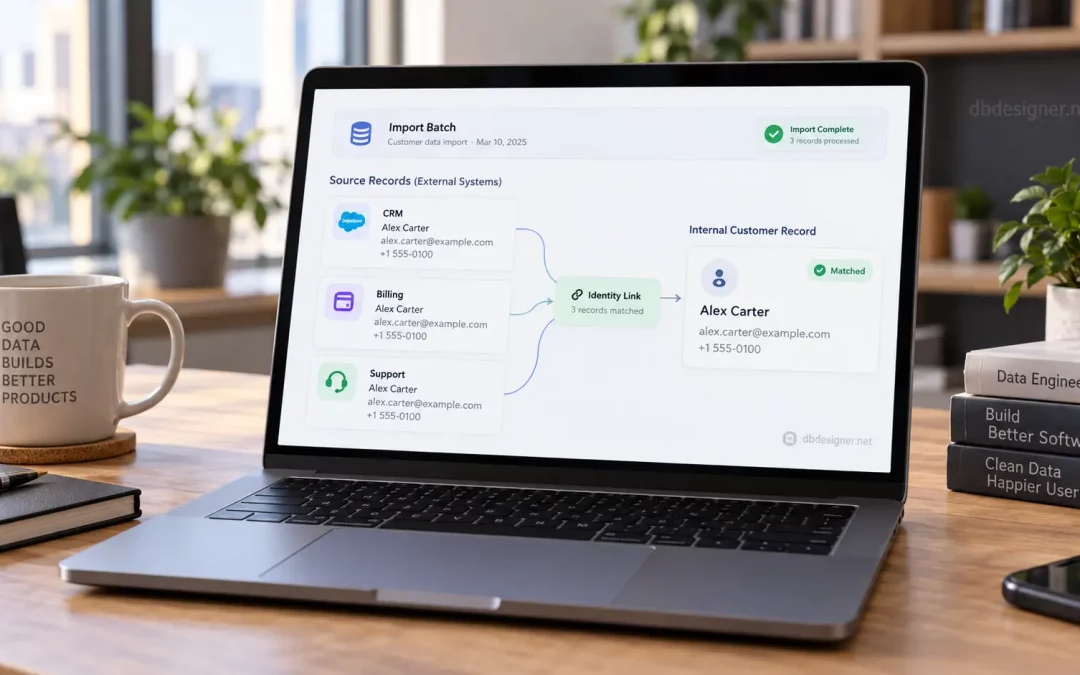
A more resilient database schema usually separates at least four concepts:
- the internal business entity
- the external source record
- the import operation
- the decision that connects an external record to an internal entity
The internal customer might look conceptually like this:
customer(id, display_name, primary_email, created_at)
But imported records should have their own identity:
external_record(id, source_system_id, source_key, imported_at, source_updated_at)
A separate relationship can then record how the source record was associated with a customer:
identity_link(external_record_id, customer_id, match_method, match_status, matched_at)
Now billing account 7712 remains a billing account record even after the database concludes that it belongs to internal customer customer 205.
This matters because the two identities have different lifecycles.
The billing provider might delete account 7712. The internal customer still exists. A different billing account could later be linked to the same customer. An incorrect match could be reversed without rewriting the history of the source data.
The relational database is no longer forced to pretend that an external identifier and an internal entity are the same thing.
Preserve Provenance Before Cleaning the Data
Import pipelines often normalize data immediately.
" Northwind Labs " becomes "Northwind Labs".
"+1 (555) 0148" becomes "+15550148".
That cleaning is useful, but throwing away the original representation creates a research problem later.
Imagine that an imported phone number suddenly begins matching the wrong customer. If the database stores only the cleaned value, investigators cannot easily determine whether the source supplied incorrect data, the transformation changed it incorrectly, or the matching algorithm made a bad decision.
A robust import design preserves provenance.
Depending on the system, you might store:
external_record(id, source_system_id, source_key, raw_payload, imported_at)
or preserve important source values in dedicated staging fields.
The exact implementation depends on privacy, storage, compliance, and operational requirements. The architectural point is more important: retain enough evidence to reconstruct why the database reached its current state.
This is especially important when importing financial records, research datasets, marketplace listings, healthcare information, or other data where corrections may need to be explained later.
Track Import Batches as First-Class Records
Another commonly omitted entity is the import itself.
If 85,000 rows arrive from a partner on Tuesday night and 2,300 of them are wrong, engineers should be able to identify exactly which operation produced those records.
An import batch can be modeled explicitly:
import_batch(id, source_system_id, started_at, completed_at, filename, status)
Then each imported record can reference it:
external_record(..., import_batch_id)
This relationship enables practical questions that become extremely difficult when imports overwrite application tables directly:
- Which records came from yesterday’s file?
- How many rows were rejected?
- Which customers were affected by a faulty import?
- Was this source record seen in previous batches?
- Can the results of one import be reviewed or rolled back?
Batch modeling turns data ingestion from an invisible background operation into something the database can describe and audit.
Model Matching as a Decision, Not an Invisible Algorithm
Many import systems eventually need record linkage or entity resolution.
A source record may match an existing customer because of an exact external identifier, verified email, phone number, organization membership, or a combination of weaker signals.
Do not hide that decision entirely inside application code if the result matters operationally.
Your relationship could capture information such as:
match_method="verified_external_id"
match_status="confirmed"
or:
match_method="email_and_phone"
match_status="needs_review"
A sophisticated system may also retain a confidence score, matching-rule version, or reviewer. Those fields are not necessary for every application, but they can be invaluable when automated reconciliation is imperfect.
This design also makes uncertainty representable.
Without it, developers are often forced into two bad choices: merge records even when the evidence is weak, or create duplicates whenever certainty is unavailable.
A third state—unresolved—is frequently closer to reality.
Re-Imports Expose Whether the Schema Really Works
The first successful import proves very little.
The second import is where the database architecture gets tested.
Suppose billing account 7712 appears again tomorrow with a corrected company name.
The system should recognize the same external record rather than invent another one. This is why the combination of source system and source identifier is usually important:
(source_system_id, source_key)
But even then, you need to decide whether you want only the latest source state or a history of what the source previously reported.
For some systems, updating the existing external record is enough.
For others, source snapshots may be useful:
external_record_version(external_record_id, observed_at, payload)
That choice should come from the actual questions the organization needs to answer, not from a reflex to preserve everything forever.
This is where database design resources can help teams reason beyond individual columns and think in terms of entities, lifecycle, and relationships.
Decide What Happens When Sources Disagree
Identity is only half the problem. Once two external records have been matched to the same customer, their attributes may conflict.
The CRM says:
company="Northwind"
The billing platform says:
company="Northwind Labs LLC"
The support system says:
company="Northwind Research"
Which value belongs in customer.company_name?
There is no universal answer.
The right investigation is to determine ownership of the fact.
Perhaps the CRM is authoritative for sales account names, while billing is authoritative for legal billing names. If those concepts are genuinely different, the schema may need two attributes rather than one field with competing writers.
That discovery is significant. What initially looked like inconsistent data may actually reveal that the original database schema collapsed two separate business concepts.
This is one reason external imports can improve data modeling: disagreement between systems exposes hidden distinctions.
Use the ER Diagram to Test the Import Architecture
Before implementing the pipeline, draw the relationships.
A useful ER diagram might contain:
source_system → import_batch → external_record → identity_link → customer
Once drawn, ask what each relationship means.
Can one customer have many external records? Usually yes.
Can one external record point to several customers? Usually that should require a very specific domain reason.
Can an external record exist without being matched? If reconciliation is uncertain, probably yes.
Can a match be replaced later? If mistakes are possible, the database architecture needs a way to represent that lifecycle.
Visual modeling makes these questions harder to ignore. An ER diagram modeling tool is particularly useful here because the difficult part of an import architecture is usually not the list of columns; it is the relationship between external identity, internal identity, and historical evidence.
A Practical Review for Your Next Import Project
Before connecting an external dataset directly to production entities, perform a short investigation.
- Profile the real data. Look for duplicates, blanks, changing identifiers, unexpected formats, and values that contradict documentation.
- Identify source-native keys. Determine how each external system identifies its own records.
- Separate source identity from application identity. Do not automatically make an external identifier your internal primary key.
- Preserve provenance. Keep enough source information to explain where important values came from.
- Record the import operation. Make batches, files, API syncs, or ingestion jobs traceable.
- Make uncertain matching representable. Do not force every record into an immediate merge-or-create decision.
- Define ownership for conflicting facts. Know which system controls which attributes—or determine whether the attributes should actually represent different concepts.
- Test the second import. Re-import changed records and observe whether identities remain stable.
These steps prevent a large class of problems that cannot be fixed merely by improving CSV parsing or adding more validation.
The Real Import Problem Is Identity
Data imports are often treated as plumbing: read fields, transform values, insert rows.
But every imported row makes a claim.
It claims that a particular external record exists. It may claim that this record corresponds to an entity your application already knows. It brings facts from a source with its own assumptions, history, and definition of identity.
A strong database schema preserves those distinctions instead of erasing them during ingestion.
When external records, internal entities, import batches, and matching decisions are modeled separately, difficult questions become answerable. Engineers can trace where data came from, investigate incorrect merges, reprocess failed imports, and reconcile disagreement without rewriting history.
The best import architecture does more than move data between systems. It preserves the evidence needed to understand what that data actually means.
Recent Comments