
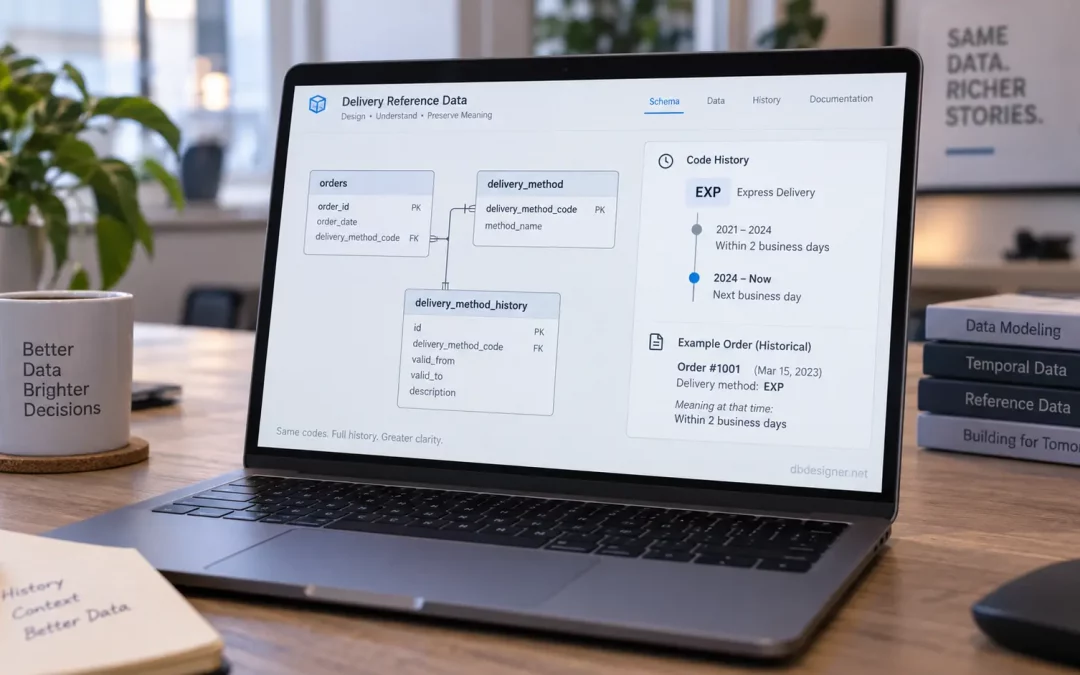
When Reference Data Changes: Designing Database Codes That Preserve History
A shipping database contains an order from 2022 with the delivery method EXP.
Today, EXP means “Express Delivery — next business day.”
But in 2022, the same code meant “Express Delivery — delivery within two business days.”
The order itself has not changed. The reference value has.
If the application simply joins the historical order to the current delivery_methods row, it silently rewrites the meaning of the past.
This problem appears in far more systems than developers initially expect. Tax categories change. Product classifications are renamed. Risk levels are redefined. Geographic regions are reorganized. Subscription plans change benefits. Employee grades acquire new salary bands. Medical codes are revised. Shipping services change their promises.
These values often look like harmless lookup data during database design. In reality, some reference data has a lifecycle of its own.
The important design question is not merely, “What values are allowed?” It is:
When a value changes, should historical records inherit the new meaning or preserve the meaning that existed when the record was created?
The lookup-table assumption that causes the problem
A conventional relational database might begin with two simple structures:
orders(id, placed_at, delivery_method_id)
delivery_methods(id, code, name, description)
Suppose the reference data contains:
7 | EXP | Express Delivery | Within two business days
An order created on May 12, 2022 stores delivery_method_id = 7.
Two years later, operations changes the service. Express delivery now promises next-business-day arrival. Someone updates row 7:
7 | EXP | Express Delivery | Next business day
The update looks perfectly reasonable. There is still one delivery method called EXP, so why create another record?
Now open the 2022 order.
The database reports that the customer selected next-business-day delivery, even though that service did not exist under that definition when the order was placed.
No transaction row was modified. No audit log reports a change to the order. Yet the historical record has acquired a different meaning.
This is one of those database problems that is difficult to notice because the rows remain technically valid.
Investigate meaning before choosing a schema
Before introducing temporal tables or version columns, investigate how the reference value is actually used.
Take a small sample of real reference data and ask what happens when each field changes.
Imagine this record:
plan_code = PRO
display_name = Professional
monthly_projects = 100
storage_gb = 500
support_level = priority
Now test several possible changes.
- The marketing team renames “Professional” to “Business.”
- The storage allowance increases from 500 GB to 1 TB.
- The project limit changes from 100 to unlimited.
- The company stops selling the plan to new customers.
- Existing customers are allowed to keep the old benefits.
These changes do not all have the same database meaning.
A display-name correction might safely apply everywhere. A new storage entitlement probably should not change the contractual interpretation of an invoice from three years ago. Removing the plan from sale should not make old subscriptions invalid.
This is where database research matters. Ask product managers, support staff, analysts, accountants, and developers questions based on historical scenarios rather than abstract schema terminology.
For example:
If I open a January 2024 invoice in 2027, should it show the plan benefits that existed in January 2024 or whatever the plan offers in 2027?
That question often produces a much clearer requirement than asking whether the system “needs temporal data.”
Reference data is not always timeless data
Teams often mentally divide database tables into two groups: important transactional tables and simple lookup tables.
That distinction is useful, but it can hide an important fact.
A lookup table can describe something whose meaning changes through time.
Consider:
- tax rates
- currency classifications
- insurance risk categories
- job grades
- shipping service levels
- regulatory classifications
- membership tiers
- product categories used in reporting
If historical records depend on the definition of those values, the lookup table is participating in historical truth.
The database schema therefore needs to represent more than the identity of the classification. It may also need to represent which version of that classification applied.
Weak approach: overwrite the reference row
The simplest implementation keeps one row per code and updates it whenever the business definition changes.
This can be correct when changes are purely cosmetic.
If INTL_STANDARD is renamed from “International Standard” to “Standard International,” perhaps every screen should immediately use the new wording.
The problem appears when mutable columns influence historical interpretation.
Imagine a risk-rating table:
risk_levels(id, code, label, minimum_score, maximum_score)
In 2024:
MEDIUM | 40 | 69
In 2026, the organization changes the scoring policy:
MEDIUM | 50 | 74
If the existing row is updated, analysts examining a 2024 assessment may conclude that a score of 45 should never have been classified as medium.
The current policy has contaminated the interpretation of old data.
Overwriting reference data is therefore safest only when you have established that historical records are supposed to inherit the change.
A more durable model: separate identity from version
One useful schema design is to distinguish the stable concept from its changing definition.
Instead of storing everything in one table:
delivery_methods(id, code)
delivery_method_versions(id, delivery_method_id, name, description, valid_from, valid_to)
The stable table answers:
What delivery method is this?
The version table answers:
What did this delivery method mean during this period?
For example:
delivery_methods
7 | EXP
delivery_method_versions
31 | 7 | Express Delivery | Within two business days | 2021-01-01 | 2024-06-30
44 | 7 | Express Delivery | Next business day | 2024-07-01 | NULL
Now the system can preserve the fact that EXP is one recognizable business concept while also acknowledging that its definition changed.
This pattern is often called effective dating because each version has a period during which it is considered valid.
What should the transaction actually reference?
There is an important second decision.
Should an order store delivery_method_id, or should it store delivery_method_version_id?
Both models can work, but they make different guarantees.
If the order stores only the stable delivery method ID, the application must determine the appropriate version using the order date:
delivery_method_id = 7
placed_at = 2022-05-12
The query then finds the version whose effective period contains May 12, 2022.
This can be elegant when the date rules are reliable and universal.
But there is a hidden assumption: the applicable reference version can always be reconstructed later from timestamps.
That assumption sometimes fails.
A policy may be introduced retroactively. A customer may have received a negotiated exception. Data may have been imported from another system. The “effective date” used for legal reporting may differ from the transaction creation timestamp.
In those cases, storing the exact version foreign key is stronger:
orders(id, placed_at, delivery_method_version_id)
The order does not merely say that the customer selected EXP. It says exactly which definition of EXP applied.
When designing the relationship in an ER diagram modeling tool, this distinction is worth making visually explicit. A line from the transaction to the version table communicates a different historical guarantee than a line to the stable reference table.
Challenge the assumption that one date is enough
Effective-dated schemas often begin with valid_from and valid_to. That solves many problems, but it can create a false sense of completeness.
Ask what “valid” actually means.
Suppose a new tax category is approved on March 1, announced on April 15, entered into the database on April 20, and legally effective from January 1.
Which date belongs in valid_from?
Possibly January 1.
But if you need to answer, “What did our system believe on February 10?” then the legal effective date is not enough.
You are dealing with two timelines:
- when the rule applies in the business domain
- when the database learned or recorded the rule
This distinction matters in financial systems, compliance databases, scientific datasets, insurance platforms, and systems that frequently receive corrections.
Not every application needs both timelines. But discovering the requirement after years of overwriting records is expensive.
Another option: snapshot the important attributes
Versioned reference tables are not the only solution.
Sometimes the transaction should copy selected values directly.
An invoice line might contain:
product_id
product_name
unit_price
tax_rate
At first glance, storing product_name looks redundant because the name already exists in the products table.
But an invoice is often expected to remain a self-contained historical record. If the product is renamed later, the issued invoice should usually not rewrite itself.
Here, duplication serves a purpose: it creates a snapshot.
The tradeoff is that snapshots deliberately allow the stored transaction values and the current master data to diverge.
That is not necessarily bad data quality. It may be the correct model.
A useful rule is to ask whether the transaction needs to remember a reference to a concept or a statement about what was true at that moment.
References favor foreign keys. Historical statements often justify versions or snapshots.
Test the schema with uncomfortable examples
Before finalizing this kind of database architecture, create scenarios designed to break it.
Take a proposed reference table and simulate five years of changes.
Try questions such as:
- What happens when a code is renamed?
- Can a retired code still appear on old records?
- Can two versions accidentally overlap?
- What happens when a correction is backdated?
- Can an imported record refer to a definition that never existed locally?
- Should reporting use the historical classification or today’s classification?
- Can the same business concept disappear and later return?
This exercise frequently exposes requirements that static sample data misses.
It also improves ER diagrams. Instead of modeling only today’s state, you begin drawing relationships that represent the system across time.
Current reporting and historical reporting may need different answers
One subtle consequence of versioned reference data is that analysts may legitimately need two different classifications for the same record.
Imagine customers were assigned to sales regions in 2023. The company reorganizes its territories in 2026.
A finance report asking “How much revenue did the North region produce in 2023?” could mean:
How much revenue was attributed to the North region according to the territory structure that existed in 2023?
Or:
Take 2023 customers and reorganize them using today’s territory structure. What would the revenue distribution look like?
Those are different analytical questions.
If the database preserves only the current region mapping, the first question may become impossible to answer reliably.
This is why operational schema design and analytical requirements often meet around historical reference data. Preserving old classifications can be just as important as preserving old transactions.
Decide explicitly what can change history
A useful database review exercise is to inspect every foreign key to a lookup or master-data table and ask:
If the referenced row changes tomorrow, should yesterday’s record mean something different?
If the answer is clearly yes, a normal mutable reference may be appropriate.
If the answer is clearly no, investigate versioning or snapshotting.
If nobody knows the answer, that uncertainty is itself a requirement worth researching.
You can use database design resources alongside an ER diagram to document which entities represent stable identities, which represent historical versions, and which transactions capture snapshots.
The goal is not to make every lookup table temporal. That would add unnecessary complexity.
The goal is to identify the small number of reference values whose changing definitions can alter the meaning of important records.
A database should preserve the past deliberately
Historical accuracy is often discussed as if it were mainly about keeping old transaction rows.
But a transaction can remain untouched while its meaning changes around it.
If an old order points to a shipping service whose definition was overwritten, if an old assessment points to a risk category whose thresholds were replaced, or if an invoice depends on a product description that changes every year, the database may still contain the original rows while no longer representing the original reality.
That is the deeper lesson.
History lives not only in records, but also in the definitions those records depend on.
Good database design identifies which definitions are allowed to evolve silently and which ones must leave a trail.
The next time a table looks like “just reference data,” change one of its values mentally, move the calendar forward three years, and reopen an old record.
If the past suddenly tells a different story, the schema may need to remember more than a code.
Recent Comments