
The Hidden Skill in Database Design: Learning to Spot the Real Entities
Many students start learning database design by drawing tables immediately. They open a notebook, list a few columns, and feel like they are making progress.
But experienced designers know something surprising: the hardest part of schema design is not writing SQL. The hardest part is deciding what actually deserves to exist as a table.
This is where most students struggle when learning ER diagrams and schema design. The challenge isn’t technology — it’s understanding the real-world concepts behind the data.
In other words, good database design begins with learning how to spot the true entities hiding inside a problem.
A Student Scenario: The Campus Event System
Imagine your professor gives you a project:
Create a database for a university event management system.
Most students immediately start listing tables like this:
- Events
- Students
- Speakers
- Locations
This looks reasonable. But it’s only the beginning.
When you dig deeper, new questions appear:
- Can a speaker attend multiple events?
- Can students register for multiple events?
- Can an event have multiple speakers?
- Can events move to different locations?
Suddenly the simple structure becomes more complex. And this is where real database design thinking begins.
The Entity Discovery Game
Professional designers treat schema design like a detective story.
They don’t just ask “What tables do we need?”
Instead, they ask:
- What objects exist in the real world?
- What actions happen between those objects?
- Which relationships are important to remember?
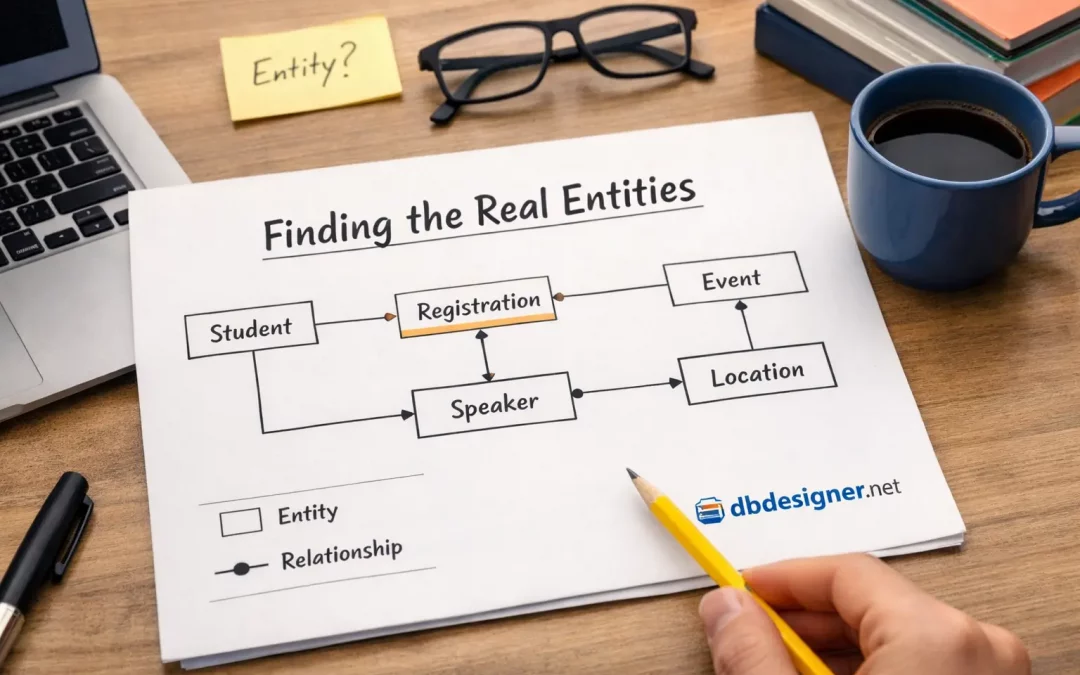
For example, in the event system, registration might actually be its own entity.
Why?
Because a registration might contain:
- Registration date
- Attendance status
- Ticket type
That means Registration is not just a relationship — it holds information of its own.
This is the moment when students begin to understand the deeper logic of ER diagrams.
The “Noun Test” Students Can Use
A practical trick for students learning schema design is something instructors sometimes call the Noun Test.
Read the system description and highlight every important noun.
Example description:
Students register for events hosted by speakers at different campus locations.
Highlighted nouns:
- Students
- Events
- Speakers
- Locations
- Registrations
These nouns often become candidate entities in your database design.
Of course, not every noun becomes a table. But this exercise helps students see the structure hidden inside everyday language.
Where Students Often Misidentify Entities
One of the biggest beginner mistakes is confusing attributes with entities.
For example:
A student might create a table like:
 Events
 - EventID
 - SpeakerName
 - LocationName
This seems simple, but it creates hidden problems.
What happens when:
- A speaker presents at multiple events?
- A location hosts many events?
- A speaker’s information changes?
Suddenly the schema becomes messy.
The better approach is recognizing that Speaker and Location are separate entities that deserve their own tables.
This shift in thinking is what transforms beginners into real database designers.
Thinking Visually with ER Diagrams
When students struggle with abstract schema design, visualization helps enormously.
Drawing ER diagrams forces you to think about relationships clearly:
- Who connects to what?
- How many connections exist?
- Which objects depend on others?
Tools like https://erd.dbdesigner.net make it easier for students to experiment with entity relationships without worrying about SQL syntax.
Instead of guessing table structures, you can visually test ideas and quickly refine your database design.
The Iteration Mindset
Students often believe database schemas should be perfect the first time.
In reality, great schema design evolves through multiple revisions.
You might start with five entities, then realize:
- Two entities should merge
- A relationship needs its own table
- An entity is missing entirely
This process of refining the structure is not failure — it’s how real systems are designed.
Platforms like https://www.dbdesigner.net allow students to experiment with schema ideas, adjust relationships, and rethink their models as they learn.
The Real Lesson for Students
Learning database design is not about memorizing rules or drawing perfect diagrams.
It’s about developing the ability to look at a messy real-world situation and ask:
What are the true entities here, and how do they relate to each other?
Once students learn to see systems this way, ER diagrams and schema design stop feeling confusing.
They become something far more interesting — a way of translating the complexity of real life into a structure that software can understand.
And that skill is what turns database design from a classroom assignment into a powerful way of thinking.
Recent Comments