
Designing a Database Backwards: A Smarter Way for Students to Learn Database Design
Most students approach database design the same way: start with entities, draw some ER diagrams, and hope everything makes sense later.
But real-world systems don’t break because you forgot an entity.
They break because you didn’t think about how the data will actually be used.
This post flips the process completely.
Instead of designing from the top down, you’ll learn how to design backwards — starting from real usage, confusion, and edge cases. This is where students begin to think like real designers.
The Backwards Design Mindset
Before you draw a single table, ask this:
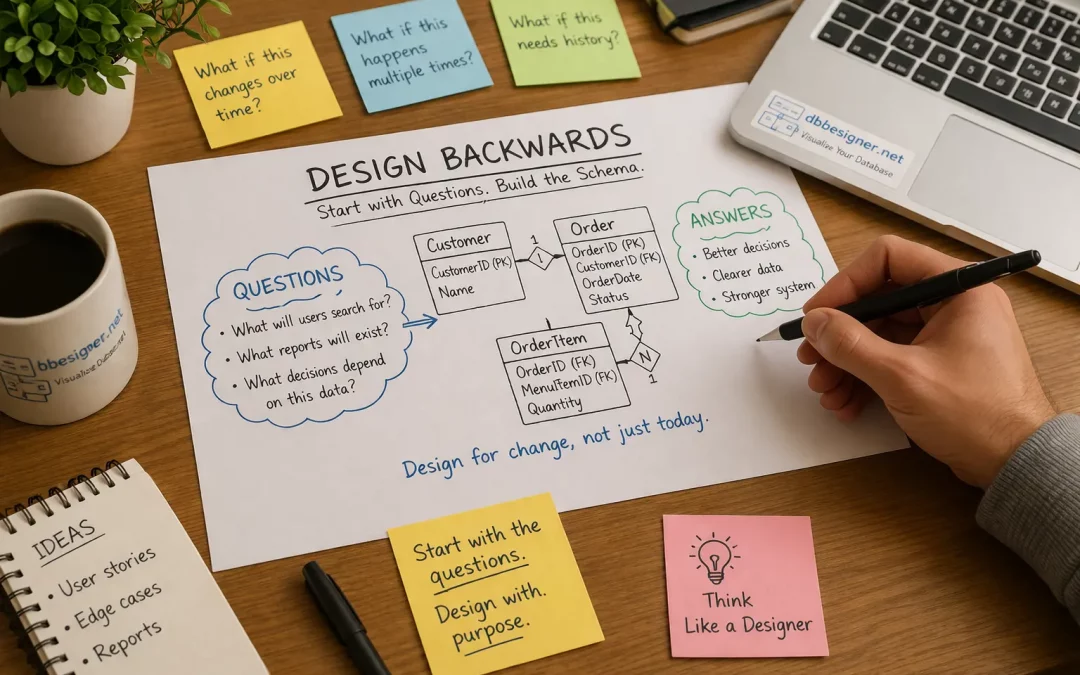
“What questions will this database need to answer?”
Not “What entities exist?”
Not “What attributes should I store?”
But:
- What will users search for?
- What reports will exist?
- What decisions depend on this data?
Because databases don’t exist to store data.
They exist to answer questions reliably.
A Scenario: The Food Delivery App
You’re a student designing a simple food delivery system.
Typical approach?
- Customer
- Restaurant
- Order
- Delivery
Looks fine. Clean. Logical.
Now let’s design it backwards.
Ask real questions the system must answer:
- “What are the most popular dishes this week?”
- “Which drivers are consistently late?”
- “How many orders were canceled after payment?”
- “Which restaurants have the highest repeat customers?”
Suddenly, your simple schema starts to feel… incomplete.
You realize:
- You need to track order status changes over time
- You need a way to record individual items per order
- You need to capture delivery timestamps, not just delivery existence
This is the moment students level up.
You’re no longer designing tables.
You’re designing answers.
The Hidden Trap: “It Works” Isn’t Enough
One of the biggest mistakes students make in schema design is stopping too early.
If your database can:
- Insert data ✔
- Retrieve basic records ✔
…you assume the design is complete.
But here’s the uncomfortable truth:
A database that “works” can still be poorly designed.
Why?
Because it might fail when:
- Requirements change
- Questions become more complex
- Data starts behaving differently than expected
Good database design anticipates questions you haven’t even been asked yet.
Designing for “What If” Moments
Try this mental exercise while building your ER diagrams:
For every entity, ask:
- What if this changes over time?
- What if this happens multiple times?
- What if this needs history?
Example:
A student might design:
- Order → Status
Seems fine.
Until you ask:
- What if an order goes from “Pending” → “Preparing” → “Out for Delivery” → “Delivered”?
Now you don’t just need a status.
You need a timeline of states.
This is where real schema design thinking begins.
From Tables to Stories
Strong database designers don’t see tables.
They see stories unfolding over time.
Each row is not just data — it’s an event, a decision, or a moment.
When students shift their thinking like this, their designs change:
- Tables become narratives
- Relationships become interactions
- Data becomes behavior
This is exactly what tools like dbdesigner.net help visualize — not just structure, but how everything connects as a system.
And when building ER diagrams using erd.dbdesigner.net, you start to see how small decisions affect the entire story of your data.
A Practical Challenge for Students
Next time you design a database, don’t start with entities.
Start with this:
“What would break if I designed this too simply?”
Then push your design until it can handle:
- Unexpected scenarios
- Repeated actions
- Historical tracking
- Conflicting data
If your schema can survive those — you’re not just designing.
You’re thinking like a database architect.
Final Thought
Students often chase the “perfect schema.”
But perfection is a trap.
The real goal of database design isn’t to get it right the first time.
It’s to design something that can adapt when reality proves you wrong.
And the fastest way to learn that?
Start from the questions.
Then design backwards.
Recent Comments