
The Impact of Schema Normalization
Database normalization is a foundational design principle that eliminates redundancy and ensures long-term scalability. By modeling schemas visually with DBDesigner, teams can apply normalization rules (1NF–3NF and beyond) intuitively—without memorizing complex theory.
“Well-normalized schemas reduce data inconsistency incidents by 72% in modern SaaS platforms.” – 2024 Data Architecture Report
Why Normalization Matters
- Data Integrity: Single source of truth for each fact
- Update Efficiency: Change data once, not everywhere
- Storage Optimization: Less duplication, lower costs
- Cleaner Models: Easier to understand and maintain
Normalization Levels Explained
With visual schema design, normalization becomes practical instead of abstract:
- First Normal Form (1NF): Atomic values, no repeating groups
- Second Normal Form (2NF): Remove partial dependencies
- Third Normal Form (3NF): Eliminate transitive dependencies
- BCNF: Stronger guarantees for complex relationships
- Controlled Denormalization: Performance-driven exceptions
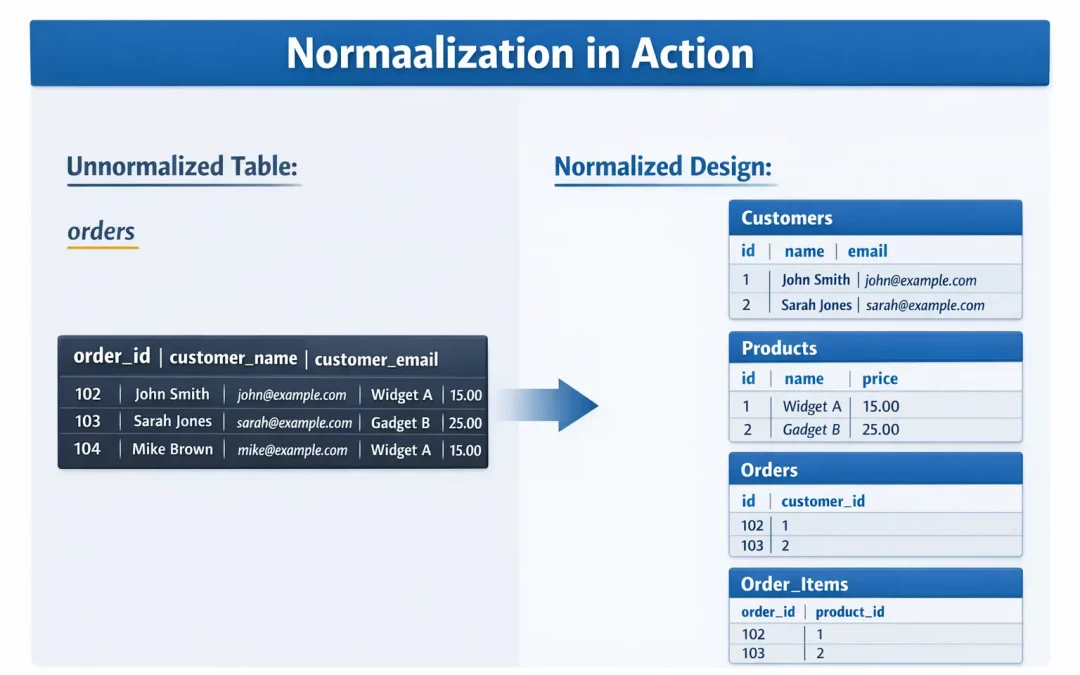
Normalization in Action
Unnormalized Table:
orders
--------------------------------------------------
order_id | customer_name | customer_email | product_name | product_price
Normalized Design:
customers (id, name, email)
products (id, name, price)
orders (id, customer_id)
order_items (order_id, product_id)
Design Improvements
- Removed duplicate customer data
- Prevented update anomalies
- Enabled clean relationships
Advanced Normalization Techniques
- Surrogate Keys: Simplify joins and indexing
- Junction Tables: Handle many-to-many relationships
- Functional Dependency Mapping: Visual dependency tracking
- AI Feedback: DBDesigner flags normalization issues automatically
Balancing Normalization and Performance
OLTP Systems
- Highly normalized schemas
- Optimized for writes and consistency
Analytics
- Selective denormalization
- Fewer joins for faster reads
Design Tools
- Visual dependency tracking
- Instant schema validation
Conclusion: Normalize with Confidence
Modern database teams rely on proper normalization to:
- Maintain consistent, reliable data
- Scale schemas as applications grow
- Reduce long-term technical debt
Design Cleaner Schemas Today
Normalize Your Database Visually (With built-in AI guidance)
For Enterprise Architectures:
Build scalable, normalized ERDs
Recent Comments