
The Importance of Choosing the Right Database Data Types
Database data types are the foundation of accuracy, performance, and scalability. Selecting the correct types ensures efficient storage, reliable calculations, and predictable behavior across systems. With DBDesigner’s visual database modeling, teams can define data types consistently across PostgreSQL, MySQL, SQL Server, MongoDB, and Snowflake—without engine-specific guesswork.
“Over 30% of production database bugs stem from improper data type selection.” – 2024 Data Engineering Quality Report
Why Data Types Matter More Than You Think
- Performance: Smaller, precise types reduce I/O and memory usage
- Data Integrity: Prevent invalid or out-of-range values
- Storage Efficiency: Avoid wasted space from oversized columns
- Cross-System Consistency: Easier migrations and integrations
Common Data Type Categories Explained
Using visual schema design, you can standardize data types across teams:
- Numeric: INT, BIGINT, DECIMAL, FLOAT for counts and calculations
- Text: VARCHAR, TEXT, CHAR for structured and free-form strings
- Date & Time: DATE, TIMESTAMP, TIME for temporal accuracy
- Boolean: TRUE/FALSE flags for logic clarity
- JSON & Semi-Structured: Flexible schemas for evolving data
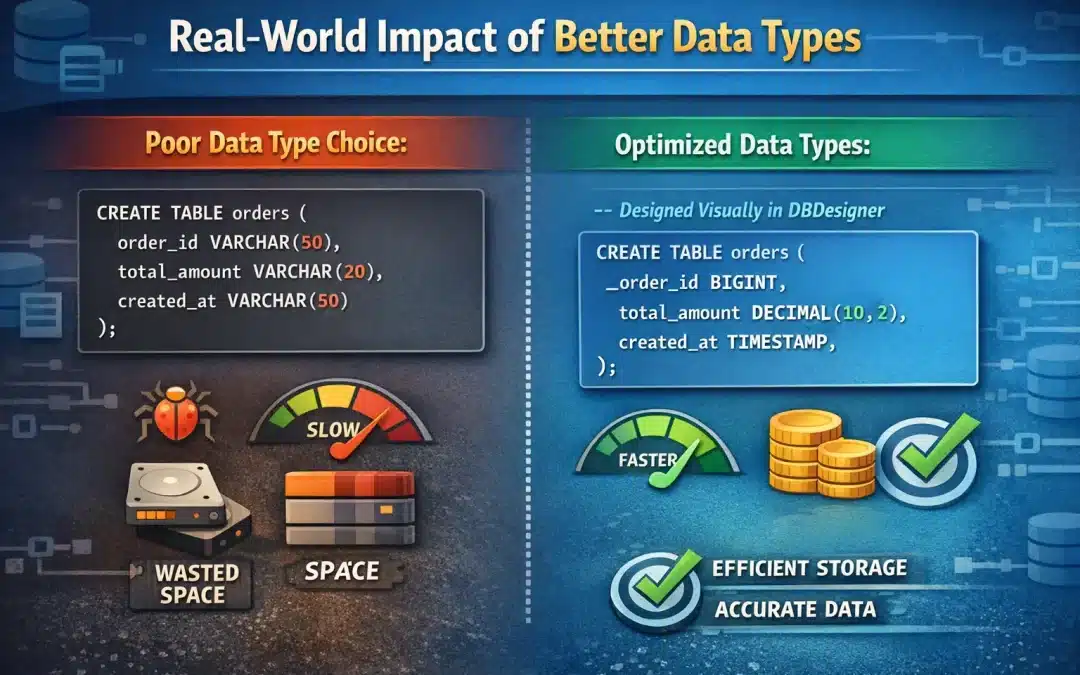
Real-World Impact of Better Data Types
Poor Data Type Choice:
CREATE TABLE orders (
  order_id VARCHAR(50),
  total_amount VARCHAR(20),
  created_at VARCHAR(50)
);
Optimized Data Types:
-- Designed visually in DBDesigner
CREATE TABLE orders (
  order_id BIGINT,
  total_amount DECIMAL(10,2),
  created_at TIMESTAMP
);
Optimization Results
- Reduced storage size by 42%
- Improved query performance by 3x
- Eliminated conversion errors in analytics
Advanced Data Type Best Practices
- Use DECIMAL for Money: Avoid floating-point rounding errors
- Right-Size Integers: INT vs BIGINT based on growth projections
- Timezone Awareness: Prefer TIMESTAMP WITH TIME ZONE
- Domain Consistency: Reuse types for emails, IDs, and statuses
Data Type Governance at Scale
Standardization
- Create shared type conventions
- Reduce schema ambiguity
Validation
- Catch type mismatches early
- Improve API and ETL reliability
Design
- Align data types with business meaning
- Model once, deploy everywhere
Conclusion: Data Types Define Data Quality
Thoughtful data type selection helps teams:
- Prevent costly production bugs
- Optimize performance and storage
- Ensure long-term schema stability
Design with Precision from Day One
Model Accurate Data Types Visually
For Growing Data Teams:
Create consistent, enterprise-ready schemas
Recent Comments