
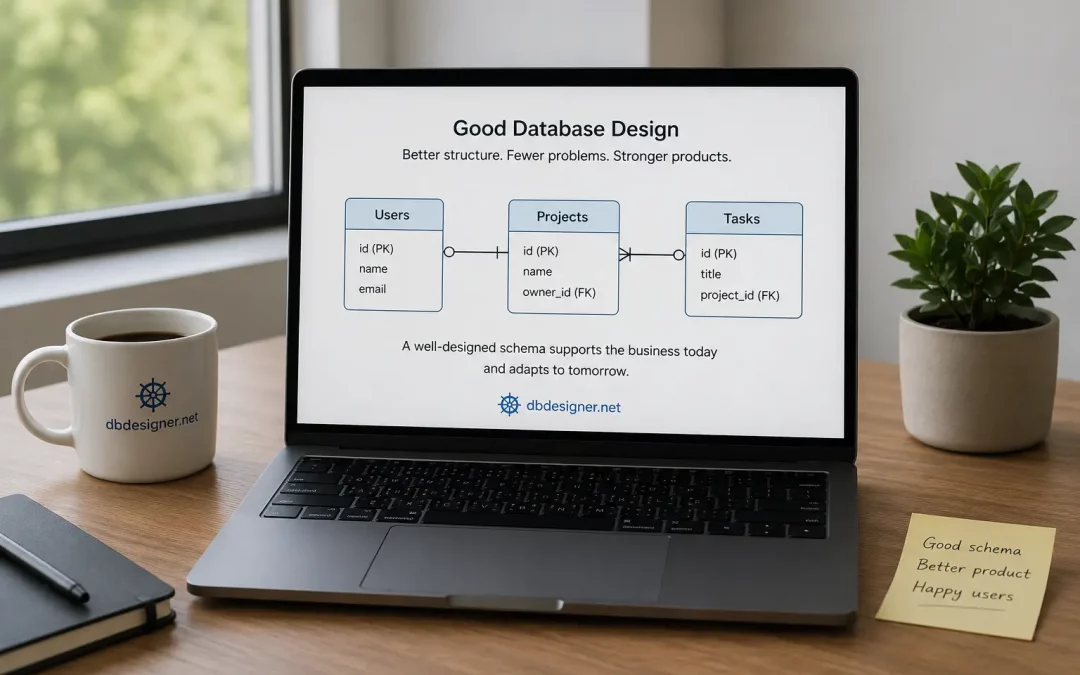
Why Weak Database Design Quietly Becomes a Product Problem
Most people think bad database design creates technical problems.
Slow queries. Messy tables. Complicated joins. Annoying migrations.
But in real products, weak schema design usually causes something far more expensive: confused business behavior.
A product starts behaving strangely because the database can no longer represent reality cleanly.
A customer belongs to two accounts, but the schema only allows one.
A subscription is both “paused” and “active” depending on which table you trust.
An employee changes departments and suddenly historical reports become inaccurate because the schema overwrote old relationships instead of preserving history.
These are not performance problems.
They are modeling problems.
And once an application grows, those modeling decisions spread everywhere: APIs, dashboards, permissions, billing logic, analytics, automation, exports, integrations, and customer support workflows.
Good database design is not just about organizing data. It is about deciding what kinds of truths your system is capable of expressing.
The Most Dangerous Schema Assumption: “This Will Always Work Like This”
Many early schemas are built around certainty.
The team assumes:
- A user has one role
- An order has one payment
- A product belongs to one category
- An employee works in one office
- A project has one owner
At first, these assumptions feel practical. They simplify the schema and help the product move quickly.
But eventually reality changes.
The moment a second role appears, or shared ownership becomes necessary, or a user belongs to multiple teams, the original schema begins resisting the business itself.
This is where weak ER diagrams quietly reveal themselves.
Not because they look messy, but because they encoded temporary assumptions as permanent truths.
Good designers understand that relationships are often more unstable than entities.
Users, products, invoices, and accounts may remain conceptually stable for years.
But relationships evolve constantly.
That is why experienced schema designers spend less time asking “What tables do we need?” and more time asking:
“How might these relationships change once the business becomes more complicated?”
A Simple Example: The “Owner” Problem
Imagine a startup building a project management tool.
The first schema is straightforward:
- Projects
- Users
- Tasks
Inside the projects table, there is a simple field:
owner_id
Easy.
Every project has one owner.
Until six months later.
Now enterprise customers want:
- multiple project managers
- temporary delegated ownership
- department-level oversight
- audit history for ownership changes
- role-based visibility rules
Suddenly, the schema itself becomes the obstacle.
The original design treated ownership as a static attribute instead of a changing relationship.
Now the engineering team has to untangle assumptions buried inside:
- queries
- permissions
- API responses
- reporting logic
- notification systems
One small schema shortcut quietly shaped the entire application architecture.
This is why thoughtful database design is less about storing information and more about representing evolving reality.
ER Diagrams Are Really Maps of Business Behavior
Many beginners think ER diagrams are just planning tools.
Boxes. Lines. Relationships.
But mature designers use ER diagrams differently.
They use them to expose hidden business assumptions.
For example, consider two different ways to model product returns in an ecommerce platform.
Option A:
A return belongs directly to an order.
Option B:
A return belongs to individual order items.
At first glance, both seem reasonable.
But they imply completely different business realities.
The first assumes returns happen at the order level.
The second assumes customers may partially return purchases.
That single relationship changes:
- refund logic
- warehouse workflows
- inventory adjustments
- customer support tooling
- analytics reporting
The schema is not passive.
It actively shapes what the product can express cleanly.
That is why strong schema designers spend enormous time debating relationships that appear small on paper.
Why Naming Matters More Than Most Teams Realize
One of the quietest sources of bad schema design is vague naming.
Teams often create tables with names like:
itemsrecordsdataentitiesobjects
These names feel flexible.
But flexibility without meaning creates confusion.
Strong schemas use names that define boundaries clearly.
For example:
- Is a “member” different from a “user”?
- Is a “customer” different from an “account”?
- Is a “transaction” a payment attempt or a completed payment?
These are not semantic debates.
They affect:
- API behavior
- reporting accuracy
- integration reliability
- business metrics
- team communication
Good database design forces teams to define meaning precisely.
And surprisingly often, the hardest part of schema design is not technical at all.
It is agreeing on what words actually mean.
The Hidden Cost of Modeling Everything as “Current State”
One of the most common modeling mistakes is treating all data as current state.
For example:
- current address
- current manager
- current subscription plan
- current inventory count
This seems harmless early on.
Until someone asks:
“What did this look like three months ago?”
Now the system struggles because history was never modeled.
Many real systems eventually discover that some information should not be stored as static attributes at all.
It should be modeled as:
- events
- state transitions
- ownership periods
- historical records
- activity logs
This changes how teams think about database design.
The question becomes:
“Is this data describing a thing, or describing something that changes over time?”
That distinction shapes the entire schema.
Why Applications Inherit the Personality of Their Schema
Every application slowly absorbs the strengths and weaknesses of its underlying data model.
Well-designed schemas create products that feel:
- consistent
- predictable
- adaptable
- easy to extend
Weak schemas create products that feel:
- fragile
- contradictory
- hard to explain
- full of edge cases
This becomes obvious when new features arrive.
In strong systems, new requirements feel additive.
In weak systems, every feature feels like surgery.
Engineers start creating workaround columns.
Temporary flags become permanent.
Meaning drifts across tables.
Different teams interpret the same data differently.
And eventually, nobody fully trusts the system anymore.
This is why schema decisions made early in a product’s life can influence years of operational behavior.
A Better Way to Think About ER Diagrams
Many tutorials teach ER diagrams as static documentation.
But the best teams use them as thinking tools.
A good ER diagram does not merely describe tables.
It helps reveal:
- where assumptions exist
- where relationships may evolve
- where ambiguity still exists
- where the business lacks clear rules
- where future complexity is likely to appear
That is why drawing schemas visually remains valuable even for experienced engineers.
Tools like DBDesigner and the online ER diagram editor at erd.dbdesigner.net are useful not because diagrams are decorative, but because visual modeling exposes weak assumptions faster than raw SQL ever can.
A relationship that looks harmless in code often looks suspicious immediately once visualized.
The diagram becomes a mirror for the business model itself.
The Real Goal of Schema Design Is Not Perfection
One of the biggest misconceptions about schema design is that good designers somehow predict the future perfectly.
They do not.
In reality, strong database design accepts that requirements will change.
The goal is not to create a flawless permanent structure.
The goal is to create a model that can evolve without collapsing.
That means:
- separating concepts cleanly
- being careful with relationships
- preserving meaning over time
- avoiding assumptions disguised as rules
- thinking beyond the immediate feature request
Good schemas are resilient.
Not rigid.
The Most Valuable Database Design Skill Is Interpretation
People often assume database experts are primarily technical.
But the strongest designers are usually excellent interpreters.
They listen carefully when businesses describe workflows.
They notice contradictions.
They identify vague terminology.
They recognize unstable assumptions.
And they understand that modeling reality is never just a technical exercise.
It is an exercise in translating messy human systems into structured constraints.
That is why good database design often feels invisible when done well.
The application simply behaves logically.
Users rarely encounter contradictions.
Features extend naturally.
The product feels coherent.
Behind that smooth experience is usually a schema that respected reality instead of oversimplifying it.
Conclusion
The most important database decisions are rarely about syntax.
They are about meaning.
Every table, relationship, and constraint quietly defines how a system understands the world.
Weak schemas create technical debt, yes.
But more importantly, they create conceptual debt.
The application starts carrying assumptions that no longer match reality.
And once that gap appears, complexity spreads everywhere.
Good schema design is ultimately an act of careful representation.
Not just organizing data, but deciding which truths matter, which relationships may evolve, and which assumptions deserve skepticism before they become permanent.
That is why the best ER diagrams are not merely technical artifacts.
They are snapshots of how a business believes the world works at a particular moment in time.
And the quality of those assumptions often determines whether a product grows smoothly or slowly collapses under the weight of its own contradictions.
Recent Comments