
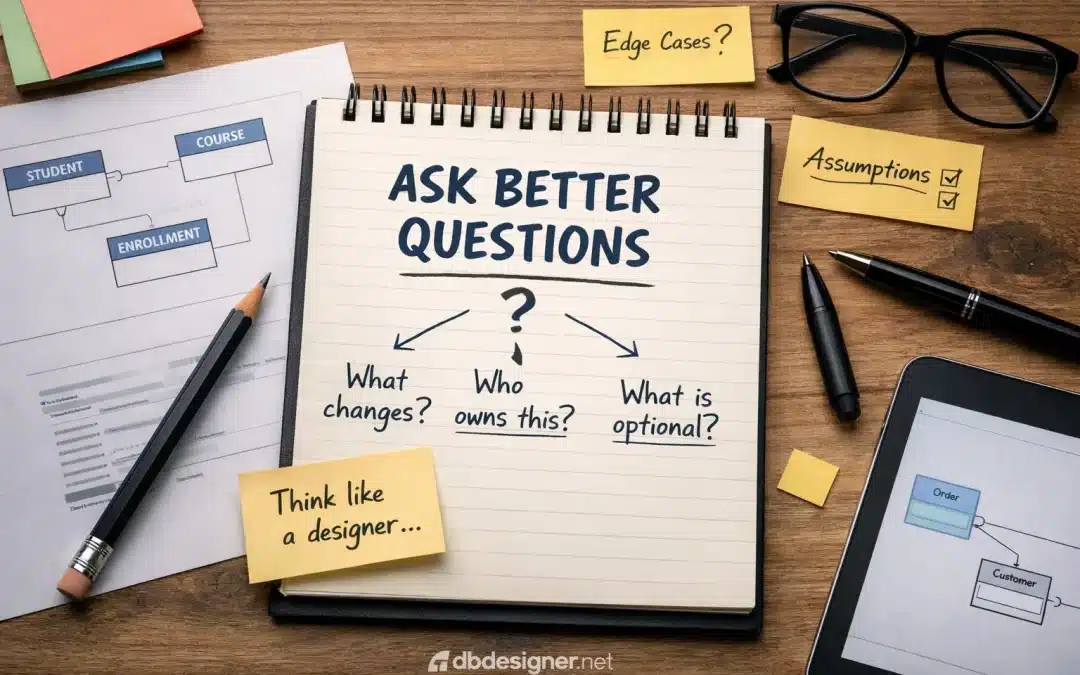
The Hidden Skill in Database Design: Asking Better Questions
Most students think learning database design means mastering ER diagrams, memorizing symbols, and translating requirements into tables.
But here’s the uncomfortable truth:
Bad questions create bad schemas.
If you want to truly understand schema design, you need to learn how to interrogate reality before you ever open a design tool.
This post isn’t about definitions. It’s about developing the habit that separates students who pass exams from students who build systems that actually survive.
The Illusion of Clear Requirements
Your professor gives you a project:
“Design a database for a car rental company.”
Simple, right?
- Car
- Customer
- Rental
- Payment
You quickly sketch an ER diagram. Add foreign keys. Done.
But a real database designer pauses and asks:
- Can a rental include multiple drivers?
- What happens if a car is returned late?
- Can a car belong to multiple branches over time?
- Do we store driver license scans?
- Can a customer have multiple active rentals?
Suddenly, the “simple” problem isn’t simple anymore.
Learning database design as a student isn’t about drawing faster. It’s about seeing hidden complexity.
Database Design Is Structured Curiosity
Think of ER diagrams as maps of assumptions.
Every relationship you draw says:
“I believe this is how the world works.”
And many student schemas fail because those beliefs go unchallenged.
Example:
A student designs this relationship:
Customer → places → Order (1-to-many)
Seems reasonable.
But what if:
- Two people split the payment?
- A parent places orders for a child?
- A corporate account places orders on behalf of employees?
Your “simple” one-to-many assumption just collapsed.
Great database designers don’t assume. They investigate.
The Three Questions Students Rarely Ask
1. What changes over time?
Students design everything as static.
But real-world systems move.
- Addresses change.
- Prices change.
- Product names change.
- Employees change departments.
If you don’t ask what evolves, your schema design becomes brittle.
Instead of asking “What fields does this entity have?” ask:
“Which of these facts might be different next year?”
That single question transforms your design mindset.
2. Who owns the truth?
Imagine you store a customer’s total order amount inside the Customer table.
It feels convenient.
But now ask:
Is the Customer responsible for calculating totals, or are Orders?
Ownership matters in database design. When two places can update the same fact, confusion begins.
Clear schema design assigns responsibility. Every fact should have one authoritative home.
3. What is optional — and why?
Students often allow NULL everywhere.
But optional data tells a story.
If “ReturnDate” is optional, what does that mean?
- The rental is active?
- The return was forgotten?
- The car was lost?
Optional fields should reflect business reality — not developer laziness.
From Story to Structure
Here’s a practical exercise for students learning database design:
Take a short story, like this:
A university offers courses. Students enroll in courses. Professors teach courses. Some courses have multiple professors. Students receive grades.
Before drawing ER diagrams, rewrite the story as rules:
- A student can enroll in many courses.
- A course can have many students.
- A course can have many professors.
- A professor can teach many courses.
- A grade belongs to a student within a course.
Notice what happened?
You transformed vague narrative into precise relationships.
This is the heart of schema design: translating messy language into structured meaning.
Tools like https://www.dbdesigner.net or the dedicated ER diagram workspace at https://erd.dbdesigner.net can help you visualize these relationships clearly — but the clarity must come from your thinking first.
The “Overconfidence Trap” in Students
Many students stop designing the moment their diagram “looks complete.”
Boxes connected. Crow’s feet aligned. No obvious gaps.
But here’s a professional trick:
Break your own schema.
Ask yourself:
- What data would be impossible to store here?
- What real scenario doesn’t fit this structure?
- Where would duplication quietly appear?
If you can’t break it, you probably understand it.
If you can break it easily, you just learned something valuable.
Designing for Humans, Not Tables
At its core, database design is about modeling human activity:
- People buying things.
- People teaching courses.
- People reserving rooms.
- People collaborating on projects.
Tables are just containers.
The real challenge is understanding behavior.
When students focus only on tables, they miss the system.
When they focus on behavior, the tables become obvious.
A Challenge for Every Student
Next time you’re assigned a database design project:
- Do NOT start with tables.
- Write down assumptions.
- List edge cases.
- Identify changing facts.
- Only then create your ER diagrams.
This approach feels slower.
But it produces stronger schema design — the kind that doesn’t collapse under real-world pressure.
Final Thought
Learning database design isn’t about memorizing patterns.
It’s about learning to question reality in a structured way.
The best students aren’t the ones who draw the cleanest ER diagrams.
They’re the ones who ask the most uncomfortable questions before they draw anything at all.
And that skill will outlast any tool, exam, or technology.
Recent Comments